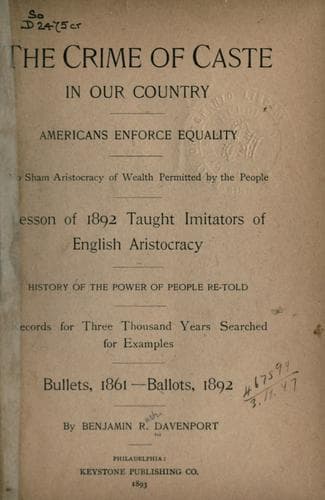
The Crime of Caste in Our CountryDavenport, Benjamin Rush
History
The Crime of Caste in Our Country
Davenport, Benjamin Rush
Social problems; United States -- Social conditions -- 1865-1918
Sherman, of Connecticut, said at the same time and place that “the
people should have as little to do directly with the government as
possible.”
John Adams repeatedly advocated, in his writings “a liberal use of
titles and ceremonials for those in office,” and the establishment
of an upper legislative chamber to be filled by “the rich, the
well-born, and the able.” The words, “well-born,” gave intense offence.
Their inconsistency with the grand democracy of the Declaration of
Independence was bitterly commented on. The whole Federalist party was
sarcastically called “the well-born”--a fatal appellation!
The expression “well-bred,” as describing the commander of the
Pennsylvania militia at Homestead, will be recalled by the mass of the
people long after every vestige of the militia’s visit to Homestead
has departed. To the American mind such expressions as “well-born” and
“well-bred” present an absurd attempt at class distinction.
Hamilton shared the same theories. He was openly accused by Jefferson,
while both men were members of Washington’s cabinet, of a desire to
overthrow the republic. He was closely connected with the rising
financial power of New York. The people, while they admired his able
and amiable personality, never quite forgave him for the part he took
in defending one Holt, a rich Tory of New York, in a suit for redress
brought by a poor widow whose house he had seized during the British
occupation.
George Washington himself, who was a Federalist so far as he belonged
to any party, was a man of ceremony and _hauteur_. He never forgot that
he had descended from a titled English family, and belonged to the
wealthiest class of Southern landed proprietors. When he assumed the
Presidency, he established an almost courtly etiquette. On Tuesdays
and Fridays he gave stately receptions to visitors; on Thursdays,
Congressional dinners. While New York was the Capital of the Union,
he had a Presidential box at the theatre (the only theatre the city
then boasted), elaborately decorated, and whenever he occupied it,
the orchestra played the “Presidential March” (now known as “Hail
Columbia”).
At his inauguration, the House of Representatives addressed him simply
as “President.” The Senate, probably cognizant of his personal wishes,
sought a more high-sounding title. “His Excellency” was rejected as too
plain, and after some debate the Senators decided upon “His Highness,
the President of the United States, and Protector of their Liberties.”
Public-domain text, read in full here on John Shaqi.
Reviews
Reviews
No reviews yet
Be the first to share your thoughts on this work.
Elsewhere in the archive
Join the Discussion
Join the discussion
Sign in to leave a comment or review.
Sign InorCreate an account