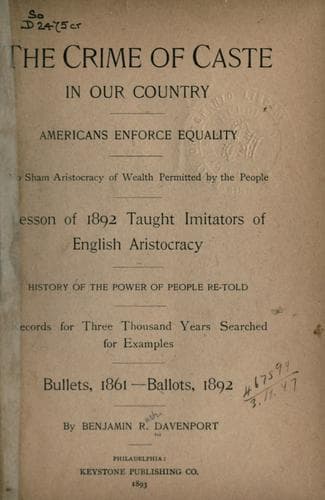
The Crime of Caste in Our CountryDavenport, Benjamin Rush
History
The Crime of Caste in Our Country
Davenport, Benjamin Rush
Social problems; United States -- Social conditions -- 1865-1918
The Senate’s suggestion was referred to the House, where it aroused no
little opposition. Congressman Tucker, of South Carolina, inquired:
“Will it not alarm our fellow-citizens? Will they not say that they
have been deceived by the Convention that framed the Constitution? One
of its warmest advocates--nay, one of its framers--has recommended it
by calling it a pure democracy. Does giving titles look like a pure
democracy? Surely not. Some one has said that to give dignity to our
government we must give a lofty title to our chief magistrate. If so,
then to make our dignity complete, we must give first a high title,
then an embroidered robe, then a princely equipage, and finally a crown
and hereditary succession. This spirit of imitation, sir, this spirit
of mimicry and apery, will be the ruin of our country. Instead of
giving us dignity in the eyes of foreigners, it will expose us to be
laughed at as apes.”
So decided was the feeling of the House against the adoption of a
sonorous title for the chief executive, that the Senate’s proposal was
dropped. Nevertheless, a more elaborate ceremonial was maintained at
the Presidential mansion--at first in New York, then in Philadelphia,
and finally at Washington--during the first twelve years of the
government, than after Jefferson’s accession in 1801.
Washington’s two elections to the Presidency was the nation’s tribute
to the splendid personal character and military record of the man
who, above all others, gave it nationality. When he refused a third
election, the honor went to John Adams, as his political heir, although
the Federalists, whose candidate Adams was, had only a bare majority
of the electoral college--seventy-one votes against sixty-eight for
Jefferson. It was at that time the almost invariable rule for the
electors to be chosen by the State Legislatures, not, as now, by
a popular vote. Had the conflict between Adams and Jefferson been
waged before the people at large, it is probable that the latter, the
champion of advanced democracy, would have been successful.
John Adams was a man of decided aristocratic tendencies. He was the
first American minister to England, and had spent ten years at the
courts of Europe. He did not conceal his admiration for English
institutions. While in London he wrote a “Defence of the American
Constitution,” which proved to be a laudation of the British form of
government rather than that of the United States. In his “Discourses
on Davilla,” he advocated a powerful centralized executive and a
system of titles. He was frequently charged with favoring a monarchy
and a hereditary legislature like the House of Lords. His political
opponents nicknamed him “the Duke of Braintree”--Braintree being the
Massachusetts town where he lived.
Public-domain text, read in full here on John Shaqi.
Reviews
Reviews
No reviews yet
Be the first to share your thoughts on this work.
Elsewhere in the archive
Join the Discussion
Join the discussion
Sign in to leave a comment or review.
Sign InorCreate an account