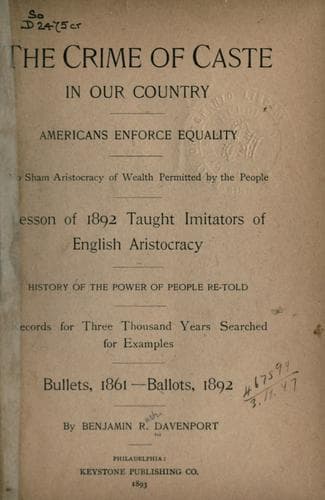
The Crime of Caste in Our CountryDavenport, Benjamin Rush
History
The Crime of Caste in Our Country
Davenport, Benjamin Rush
Social problems; United States -- Social conditions -- 1865-1918
Thus early in the existence of the nation was evident the detestation
on the part of the people at any attempted introduction of “caste” in
the country. The Stamp Act, and taxes, and unjust discrimination while
truly expressed caused the revolution in 1776, were only supplemental
causes. In the record of every colony will be found traces of the
opposition to “caste,” and the strong objection that existed among the
people to the introduction of class distinctions among them. While
the immediate cause of the rebellion on the part of the colonies,
the revolution, and consequent creation of a nation, may appear to
be the resistance to the imposition of taxes and therefore a matter
of pocketbook; still, beneath it all, the foundation upon which
the strength and duration of the resistance to the British power
rested, was the strong sentiment in the hearts of the early patriots,
demanding _equality_, social as well as “equality before the law.” Our
forefathers endured suffering at Valley Forge, not for the sake of the
pocketbook, but because they had in their bosoms that ever-present
sentiment of the Anglo-Saxon people, that all must be equal in every
respect. It is rather a petty cause to assign for the revolution and
the exhibition of heroism upon the part of the forefathers of the
Americans--a matter of taxes.
CHAPTER XIV.
THE FRENCH REVOLUTION.
Feudalism, introduced in France a thousand years ago, reconstructed
society on the only basis then possible. It was a bridge from barbarism
to monarchy. The invasion of the Northmen, though apparently a
calamity, was a blessing. They brought fresh, lusty life. Their courage
and vigor gave the country a new and needed impulse in progress and
civilization.
William, Duke of Normandy, conquered England in 1066, and proved an
able and stern ruler.
While many of her nobles were engaged in the Crusades in the East, a
social revolution was going on in France, full of significance. This
was the rise of free cities. The feudal bishops became so intolerably
oppressive that the people succeeded in buying the privilege of
electing their own magistrates; then the king, for a goodly sum of
money, confirmed it. Appeal was thus secured from the bishop to the
king. He encouraged the practice, for it freed him, to a degree, from
dependence on his nobles, and gave him greater control over the
cities. The process went on during the eleventh, twelfth, and the first
part of the thirteenth century.
The result was shown at the battle of Bouvines (A.D. 1214). King John
of England, in the hope of recovering Normandy and other provinces
which he had ignominiously lost, attacked France. He formed an alliance
with the German emperor and with the Court of Flanders.
Public-domain text, read in full here on John Shaqi.
Reviews
Reviews
No reviews yet
Be the first to share your thoughts on this work.
Elsewhere in the archive
Join the Discussion
Join the discussion
Sign in to leave a comment or review.
Sign InorCreate an account