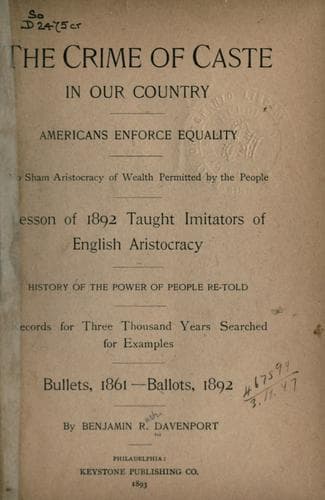
The Crime of Caste in Our CountryDavenport, Benjamin Rush
History
The Crime of Caste in Our Country
Davenport, Benjamin Rush
Social problems; United States -- Social conditions -- 1865-1918
The army of Philip, the French king, made up of barons, bishops, and
knights, clad in steel, and a large body of foot-soldiers sent by
sixteen free cities and towns, gained a complete victory. It was one of
the most memorable contests of the Middle Ages, for on that hard-fought
field three great branches of the Teutonic race--German, Flemish, and
English--went down before the furious onset of “hostile blood and
speech.” Lords, clergy, and Common People fought side by side against a
foreign foe, and henceforth were united by a common bond of pride. It
was the hardy yeomanry of Edward, the Black Prince, who won the battle
of Crecy (1346), at the beginning of the Hundred Years’ War, against
three times as many Frenchmen.
It was in 1598 that Henry IV. issued the Edict of Nantes, which
secured to the long and bitterly persecuted Huguenots the rights they
demanded. It marked a new era in history. It was the first formal
recognition of toleration in religion made by any leading power of
Europe, and anticipated a similar act in England by nearly a century.
The king saw what all have since come to see, that freedom of
conscience is one of the surest guarantees of national strength.
Henry IV. of France was essentially the people’s king. He was popular
with the masses to the same extent that Louis XV. was unpopular. To
the Common People in France, Henry IV. represented as much democracy
in that age of tyranny as Abraham Lincoln and Grover Cleveland do in a
better age and country. Henry was murdered on the streets of Paris by
the fanatic Ravaillac, whose dagger inflicted an almost mortal wound
upon France herself.
With the aid of Richelieu, the absolute power of the crown was built
up; then followed the despotisms of Louis XIV. and Louis XV.; the
revocation of the Edict of Nantes; the disastrous failure of the
Mississippi Scheme; the struggle between England and France for mastery
in the New World, and the complete triumph of the former, and the
preparation for the awful revolution of 1789.
France had materially and powerfully assisted the American colonies in
their struggle with Great Britain for independence. Many illustrious
sons of France, like Lafayette and Rochambeau, had joined and fought
side by side with those sons of liberty who were then creating the
great republic of America. America was a storehouse of freedom,
liberty, and concentrated hate of “caste” and class distinction,
from whence Frenchmen like Lafayette carried to France the spirit of
freedom. It may fairly be said that the struggle on this continent
lighted the torch of liberty which has illuminated the world since,
torn Spain’s oppressed colonies in America from her grasp, and made
possible the existence of the French Republic, which has now taken its
place among the most powerful nations of the earth.
Public-domain text, read in full here on John Shaqi.
Reviews
Reviews
No reviews yet
Be the first to share your thoughts on this work.
Elsewhere in the archive
Join the Discussion
Join the discussion
Sign in to leave a comment or review.
Sign InorCreate an account