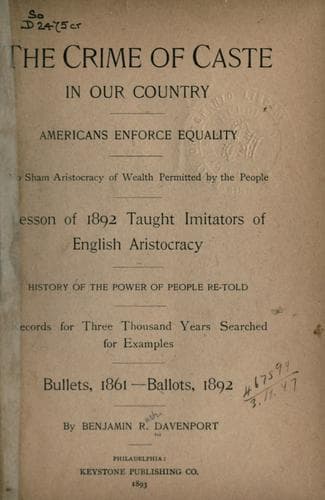
The Crime of Caste in Our CountryDavenport, Benjamin Rush
History
The Crime of Caste in Our Country
Davenport, Benjamin Rush
Social problems; United States -- Social conditions -- 1865-1918
The dormant desire had long been present in the breasts of the
poor of the French nation for equality and liberty. The quickening
influences and light radiating from the new Republic of the West,
among whose children the sons of France had served in the struggle for
independence, soon ignited the fires in the heart of the impetuous
Frenchman.
Louis XVI. had been more condescending than any of his predecessors;
he occupied, possibly, a higher position in the hearts of the people
than any king the French had had since Henry IV. But the time had come
when, inspired by the example of the Americans, the crime of “caste”
in France had become unendurable. Louis XVI. was, of all the Bourbon
kings, probably the least objectionable.
His character, while weak and influenced by the stronger will of Marie
Antoinette, did not represent the worst phases of the character of
Louis XV. or Louis XIV. Gradually, but irresistibly by attrition, the
will of the people had been making marks upon the royalty of France.
The tyranny, insolence, and arrogance of Louis XIV., in whose presence
one dared not speak, had been lessened in Louis XV. to the extent that
one could speak in a whisper; but in the presence of Louis XVI. one
might speak aloud. With tireless, resistless, sullen determination the
billows of the sea of humanity, wherein all is equality and fraternity,
had beaten upon this rock of adamant until these divine Bourbon kings
had become impressed by its constant, ceaseless energy.
Weak, amiable, and pliable as Louis XVI. was, poor Jacques had been
so long deprived of one heart-beat of feeling that his bosom could no
longer restrain the emotions of liberty and equality. The nobles of
France, more than Louis XVI., retained the impress of the reign of
Louis XIV., “the Glorious” (?), who had proclaimed that he was a Sun;
and while the ruling monarch, as the bulwark of royalty, “caste,” and
social inequality, had received the first shock of the wave and been
marked thereby; still the nobility, sheltered behind the bulwark of
the personality of the king, continued to indulge the wild license of
their privileges and “caste” distinction, gamboling like lambs upon
the greensward of their delusion, becoming fattened for the knife of
that butcher that was sure to follow, the guillotine. A more powerful,
touching, and realistic picture was never drawn of the arrogance and
presumption of the nobles, privileged classes, “higher caste,” than
that made by the people’s author, the man who of all others has nearer
touched the hearts of the Common People, who will be loved and revered
when others more learned may be forgotten, because he wrote of scenes
of sensation, emotion, and relations of the Common People--Charles
Dickens--in the “Tale of Two Cities,” and for our purpose it would be
impossible to find words more fitting than those used by this master
delineator of the feelings, thoughts, heart-throbs, and wrongs of the
Common People:
Public-domain text, read in full here on John Shaqi.
Reviews
Reviews
No reviews yet
Be the first to share your thoughts on this work.
Elsewhere in the archive
Join the Discussion
Join the discussion
Sign in to leave a comment or review.
Sign InorCreate an account