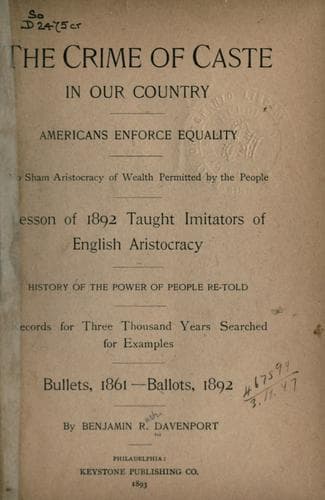
The Crime of Caste in Our CountryDavenport, Benjamin Rush
History
The Crime of Caste in Our Country
Davenport, Benjamin Rush
Social problems; United States -- Social conditions -- 1865-1918
“What has gone wrong?” said Monsieur, calmly looking out. A tall
man in a night-cap had caught up a bundle from among the feet of
the horses and had laid it on the base of the fountain, and was
down in the mud and wet, howling over it like a wild animal.
“Pardon, Monsieur the Marquis!” said a ragged and submissive man,
“it is a child.”
“Why does he make that abominable noise--is it his child?”
“Excuse me, Monsieur the Marquis, it is a pity--yes.”
The fountain was a little removed, for the street opened where it
was, into a space some ten or twelve yards square. As the tall man
suddenly got up from the ground and came running at the carriage,
Monsieur the Marquis clapped his hand for an instant on his
sword-hilt.
“Killed!” shrieked the man in wild desperation, extending both
arms at their lengths above his head and staring at him. “Dead!”
The people closed round and looked at Monsieur the Marquis.
There was nothing revealed by the many eyes that looked at him
but watchfulness and eagerness; there was no visible menacing of
anger. Neither did the people say anything; after the first cry,
they had been silent, and remained so. The voice of the submissive
man who had spoken was flat and tame in its extreme submission.
Monsieur the Marquis ran his eyes over them all as though they had
been mere rats come out of their holes. He took out his purse.
“It is extraordinary to me,” said he, “that you people cannot take
care of yourselves and your children. One or the other of you is
forever in the way. How do I know what injury you have done to my
horses. See! give him that.”
He threw out a gold coin for the valet to pick up, and all the
heads craned forward that all the eyes might look down as it fell.
The tall man called out again, with a most unearthly cry, “Dead!”
He was arrested by the quick arrival of another man, for whom the
rest made way. On seeing him, the miserable creature fell upon his
shoulder, sobbing and crying and pointing to the fountain, where
some women were stooping over the motionless bundle, and moving
gently about it. They were silent, however, as the men.
“I know all, I know all,” said the last comer. “Be a brave man,
my Gaspard. It is better for the poor little plaything to die so,
than to live. It has died in a moment without pain. Could it have
lived an hour as happily?”
“You are a philosopher, you there,” said the Marquis, smiling.
“How do they call you?”
“They call me Defarge.”
“Of what trade?”
“Monsieur the Marquis, the vender of wine.”
“Pick up that, philosopher and vender of wine,” said the Marquis,
throwing him another gold coin, “and spend it as you will. The
horses there; are they all right?”
Public-domain text, read in full here on John Shaqi.
Reviews
Reviews
No reviews yet
Be the first to share your thoughts on this work.
Elsewhere in the archive
Join the Discussion
Join the discussion
Sign in to leave a comment or review.
Sign InorCreate an account