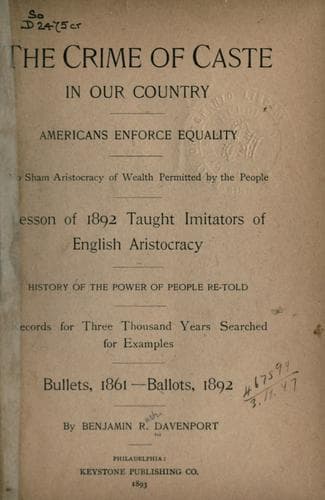
The Crime of Caste in Our CountryDavenport, Benjamin Rush
History
The Crime of Caste in Our Country
Davenport, Benjamin Rush
Social problems; United States -- Social conditions -- 1865-1918
Without deigning to look at the assemblage a second time, Monsieur
the Marquis leaned back in his seat, and was just being driven
away with the air of a gentleman who had accidentally broken some
common thing, and had paid for it and could afford to pay for it,
when his ease was suddenly disturbed by a coin flying into the
carriage, and ringing on its floor.
“Hold!” said Monsieur the Marquis. “Hold the horses! who threw
that?”
He looked to the spot where Defarge, the vender of wine, had stood
a moment before; but the wretched father was groveling on his face
on the pavement in that spot, and the figure that stood beside him
was the figure of a dark, stout woman, knitting.
“You dogs!” said the Marquis, but smoothly, and with an unchanged
front, except as to the spots on his nose; “I would ride over any
of you very willingly, and exterminate you from the earth. If I
knew which rascal threw at the carriage, and if that brigand were
sufficiently near it, he should be crushed under the wheels.”
So cowed was their condition, and so long and hard their
experience of what such a man could do to them, within the law and
beyond it, that not a voice or a hand, or even an eye was raised.
Among the men not one. But the woman who was knitting looked up
steadily, and looked the Marquis in the face. It was not for his
dignity to notice it; his contemptuous eyes passed over her and
over all the other rats; and he leaned back in his seat again, and
gave the word, “Go on!”
In vain would we seek for words describing better the horrible
condition of the Common People, and the tremendous extent of the
assumption of a superiority upon the part of the nobles, than in
the foregoing picture so ably portrayed by Charles Dickens. Such a
condition of the social life in France could produce but one result.
The harvest was ripe for the sickle. The people had witnessed an
illustration of the might of the Common People of America when opposed
to the representatives of “caste” in the British army. That the storm
should have burst that so long had been hovering over the heads of
the French nobles is not a matter of surprise, in view of the fact
that Dickens is historically correct in his picture of the oppressed
condition of the poor in France. The only wonder to us Anglo-Saxons is
that brave men, as the Frenchmen are, should have borne so long the
cruel, heartless oppression of the rich nobility.
Duruy says: “The French Revolution was the establishment of a new order
of society, founded on justice, not privileges. Such changes never take
place without causing terrible suffering. It is the law of humanity
that all new life shall be born in pain.”
When Louis XVI. ascended the throne, in 1774, revolution was in the
air. The outward splendor of Versailles, as Carlyle intimates, was the
rainbow above Niagara: beneath was destruction.
Public-domain text, read in full here on John Shaqi.
Reviews
Reviews
No reviews yet
Be the first to share your thoughts on this work.
Elsewhere in the archive
Join the Discussion
Join the discussion
Sign in to leave a comment or review.
Sign InorCreate an account