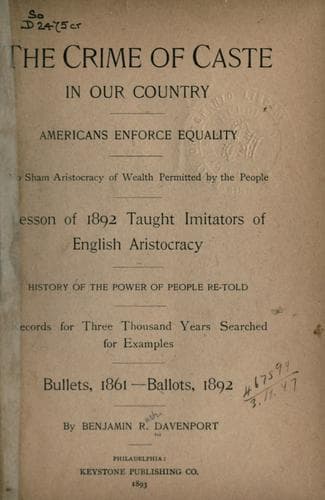
The Crime of Caste in Our CountryDavenport, Benjamin Rush
History
The Crime of Caste in Our Country
Davenport, Benjamin Rush
Social problems; United States -- Social conditions -- 1865-1918
There was a general feeling that a crisis was at hand. The spirit of
free inquiry aroused by the leading writers and thinkers was ominous.
Government, religion, social institutions, were all burned in the
crucible, and a new order of things was inevitable. The country was
hopelessly deep in the mire of debt; the tax agents were brutal, and
the peasants ground to the lowest depths of misery and suffering.
The power of the nobles over the peasants living on their estates was
absolute. Large tracts of land were declared game-preserves, where wild
boars and deer roamed at pleasure. To preserve the game with its flavor
unimpaired, the starving peasants were not allowed to weed their little
plots of ground. The nobility and clergy, who owned two-thirds of the
land, were nearly exempt from taxation.
The peasant must grind his corn at the lord’s mill; bake his bread
in the lord’s oven, and press his grapes at the lord’s wine-press,
paying whatever the lord chose to charge. If the wife of the seigneur
fell ill, the peasants must beat the neighboring marshes all night to
prevent the frogs from croaking, and so disturbing the lady’s rest.
French agriculture had not advanced beyond the tenth century, and the
plow in use was the same as that used before the Christian era. The
picture of rural wretchedness is completed by the purchase and sale of
150,000 serfs with the land on which they were born.
Louis desired to redress the wrongs of his country, but did not know
how. Ministers came and went in a continuous procession, Turgot,
Necker, Colonne, Brienne, and Necker again, tried to solve the problem,
and gave up in despair.
As a last resort, the States-General, which had not met for one hundred
and seventy-five years, assembled May 5, 1789, and that day marked the
opening of the Revolution.
The National Assembly, proving to be the most powerful body of the
States-General, invited the nobles and clergy to join it, and declared
itself the National Assembly. Louis closed the hall. The members
repaired to a tennis-court near by, and swore not to separate until
they had given France a constitution. The weak king soon yielded, and,
at his request, the coronets and mitres met with the commons. The
court decided to overawe the refractory Assembly, and collected 30,000
soldiers about Versailles.
Four members of that assembly were Lafayette, Count Mirabeau,
Robespierre, and Guillotine, inventor of the fearful instrument of
punishment bearing his name.
The Paris populace were infuriated by the menace from the soldiers.
They stormed the old Bastile and razed its dungeons to the ground.
The insurrection spread like a prairie-fire. Chateaux were burned,
and tax-payers tortured to death. Soon a maddened mob surged toward
Versailles, screeching “Bread! bread!” The palace was sacked and the
royal family brought to Paris.
Public-domain text, read in full here on John Shaqi.
Reviews
Reviews
No reviews yet
Be the first to share your thoughts on this work.
Elsewhere in the archive
Join the Discussion
Join the discussion
Sign in to leave a comment or review.
Sign InorCreate an account