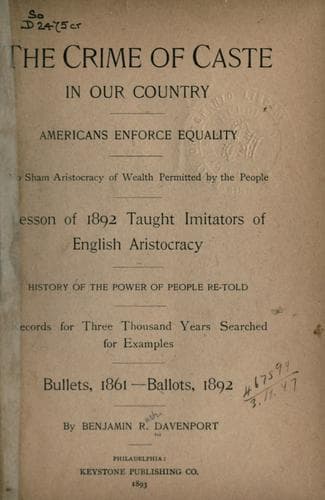
The Crime of Caste in Our CountryDavenport, Benjamin Rush
History
The Crime of Caste in Our Country
Davenport, Benjamin Rush
Social problems; United States -- Social conditions -- 1865-1918
Political clubs sprang up like mushrooms, chief among which were the
Jacobins and the Cordelies, whose leaders, Robespierre, Marat, and
Danton, advocated sedition and organized the revolution.
The Assembly, in its burst of patriotism, extinguished feudal
privileges, abolished serfdom, and equalized taxes. The estates of the
clergy were confiscated, and upon this security notes were issued to
meet the expenses of the government.
Austria and Prussia took up arms in behalf of Louis, and invaded
France (1791). This step doomed the monarch and the monarchy. The
approach of the “foreigners” kindled to unrestrainable fury the wrath
of the masses. The “Marseillaise” was heard for the first time on the
streets of Paris; the palace of the Tuileries was sacked; the faithful
Swiss guards were slain, and Louis sent to prison. The Jacobins were
triumphant. They arrested all who spoke against their revolutionary
projects; assassins were hired to go through the crowded prisons
and murder the inmates. For four days during September the terrible
carnival of blood raged.
The Prussian army was checked at Valmy, and soon recrossed the
frontier. Then the Austrians were defeated at Jemmapes, and Belgium
was proclaimed a republic. The leaders of the French revolution were
electrified, and the next Assembly established a republic in France.
The king was arraigned and guillotined. As the bleeding head tumbled
into the basket the furious crowds shouted “_Vive la Republique!_”
Europe was horrified, and a league, with England as its moving spirit,
was formed to avenge the death of Louis. The royalists held Marseilles,
Bordeaux, Lyons and Toulon.
The Convention appointed a Committee of Safety, which knew neither
mercy nor pity. Revolutionary tribunals were set up, and the work
of slaughter began and raged with a ferocity beyond the power of
imagination to conceive. To charge a person with being in sympathy
with the aristocrats was his death warrant. Men saved themselves by
denouncing their neighbors before their neighbors could denounce them.
Intimate friends suspected each other, and members of the same family
became mortal enemies.
Marie Antoinette, her head silvered by the awful woe and desolation
and horror, perished on the same scaffold where her husband had died.
At Lyons, the guillotine was too slow, and the victims were mowed down
with grape-shot; at Nantes, boat-loads were rowed out and sunk in the
Loire. The people were made frantic by their thirst for blood.
Marat rubbed his hands and chuckled with glee at the carnival of
murder. He showed his admiring friends his reception room, papered with
death warrants.
But his turn speedily came. Charlotte Corday, a young girl from
Normandy, gained access to him, and, while he was jotting down the
names of fresh victims, stabbed him to death, and then walked proudly
to the guillotine.
Public-domain text, read in full here on John Shaqi.
Reviews
Reviews
No reviews yet
Be the first to share your thoughts on this work.
Elsewhere in the archive
Join the Discussion
Join the discussion
Sign in to leave a comment or review.
Sign InorCreate an account