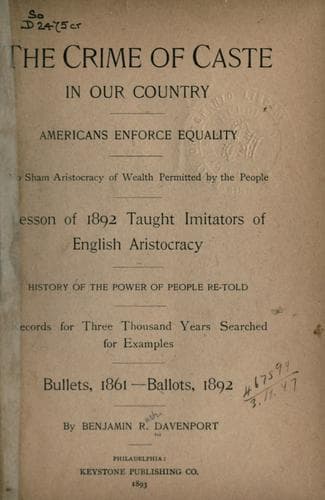
The Crime of Caste in Our CountryDavenport, Benjamin Rush
History
The Crime of Caste in Our Country
Davenport, Benjamin Rush
Social problems; United States -- Social conditions -- 1865-1918
Danton expressed a suspicion that the massacre had continued long
enough, for which he was promptly guillotined, and then for nearly
four months the appalling Robespierre reigned supreme. His aim was
to destroy all the other leaders; the axe worked faster and faster,
but not fast enough to suit the clamoring tigers; the accused were
forbidden defence, and were tried _en masse_.
Finally, when common safety demanded it, friends and foes united for
the overthrow of the colossal monster. He was arrested and beheaded
July 28, 1794. The reign of terror ended with his life. It had lasted
little more than a year. But what a year of woe, massacre, murder, and
blood! From the first outbreak of the revolution to its close, it has
been estimated that 1,000,000 lives were sacrificed.
From this appalling furnace of fire and death emerged the true life of
France. The revolutionary clubs were abolished; the prison doors flung
wide; the churches opened, and the emigrant priests and nobles invited
to return.
But, though the Convention had organized the government of the
Directory in name, it had yet to fight for its existence. The Royalists
hoped they might restore the monarchy. The National Guard was persuaded
to join the monarchical party. In October, 1795, the combined forces,
40,000 strong, marched on the Tuileries to expel the Convention or
prevent the establishment of the Directory.
The Convention called on General Barras to defend them. Barras asked
a Corsican artillery officer of twenty-six, who had distinguished
himself at Toulon, to act as his lieutenant. He speedily converted the
palace into an intrenched camp. He had 7000 troops, but he planted his
batteries with such admirable skill, and used his grape-shot with such
effect that the advancing hosts were defeated and scattered, and the
Convention, with its defender, Napoleon Bonaparte, was master of the
situation.
Thankfulness should fill the hearts of all the citizens of the
American Republic that the history of our own country will not
present a duplicate picture of the scenes portrayed in this chapter.
It certainly is not the fault of the good management of the sham
aristocrats that these scenes of such monstrous horror, exhibiting the
birth of liberty in France and the erasure of the word “caste” with
its most objectionable features from French life, were not reproduced
in America. Fortunately for the would-be aristocrats, the volcano,
upon which they slept, had a crater known as the BALLOT-BOX, where
the pent-up steam of the indignation of the people found a vent-hole.
November 8, 1892, the safety-valve was opened by the people, and the
believers in “caste” should be thankful that there existed some means
of relief; had such not been the case, the pent-up energies and the
indignation of the people would have caused another explosion, which
would have rivalled in force, if not in the howling scenes of blood,
the French Revolution.
CHAPTER XV.
ENGLAND, 1645.
Public-domain text, read in full here on John Shaqi.
Reviews
Reviews
No reviews yet
Be the first to share your thoughts on this work.
Elsewhere in the archive
Join the Discussion
Join the discussion
Sign in to leave a comment or review.
Sign InorCreate an account