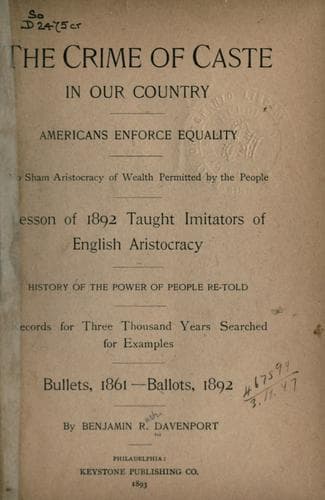
The Crime of Caste in Our CountryDavenport, Benjamin Rush
History
The Crime of Caste in Our Country
Davenport, Benjamin Rush
Social problems; United States -- Social conditions -- 1865-1918
The American regards England with more than kindly eyes. Her history
has been the history of our race. The sterling valor of the Englishman
early made itself felt in the demands made by him upon the reluctant
kings who ruled him. At no time in the history of Great Britain,
from the Norman Conquest, had the peasantry and “Common People” been
submerged as completely by the power of the privileged classes as has
been the case in France, and, in fact, as in all of continental Europe.
When John, known as “Lackland,” the younger brother of Richard Cœur
de Lion, came to the throne of England (1109-1216), he ruled weakly
and lost nearly all the English possessions in France. The peasants
rose against the imbecile monarch and, joined by the barons and feudal
lords, compelled him to sign the Magna-Charta or Great Charter, at
Runnymede (1215).
By this immortal instrument the king gave up the right to demand money
when he pleased, to imprison or punish when he pleased. He was to take
money only when the barons granted the privilege, for public purposes,
and no freeman was to be punished except when his countrymen judged him
guilty of crime. The courts were to be open to all, and justice was
not to be sold, refused, or withheld. The serf villein was to have his
plow free from seizure. The church was secured against the interference
of the king. No class was neglected, but each obtained some cherished
right.
Thus, early in the history of England, we find the “Common People” of
that nation from whom we derive our blood and many of our laws--the
foundation, in fact of all of them--and much of our domestic and
social conditions and manners, asserting rights for which Americans
afterwards contended with the parent country, England. The Magna-Charta
was wrested from King John not by the lords and barons alone--but by a
union between the nobles and the “Common People.”
Thus early the “Common People” of England learned to appreciate their
might and strength. And the Americans, as inheritors along with their
blood of so many of the traditions and characteristics of the English,
have not failed to possess themselves of that quality which is inherent
in the Anglo-Saxon heart--the fearless demanding of the right to
equality.
Pronouncedly did the American people, November 8, 1892, reiterate in an
unmistakable manner the sentiment of the race who, in 1214, had forced
from King John of England the Magna-Charta which has been, ever since,
the foundation of English liberty.
English kings have continually tried to break the Magna-Charta, but
have ever failed in the attempt. They have been compelled, during
reigns succeeding that of King John, to confirm its provisions
thirty-six times. The early assertion of the right to representation
by the people is interesting as a step onward in the march of the
Anglo-Saxon toward equality and liberty.
Public-domain text, read in full here on John Shaqi.
Reviews
Reviews
No reviews yet
Be the first to share your thoughts on this work.
Elsewhere in the archive
Join the Discussion
Join the discussion
Sign in to leave a comment or review.
Sign InorCreate an account