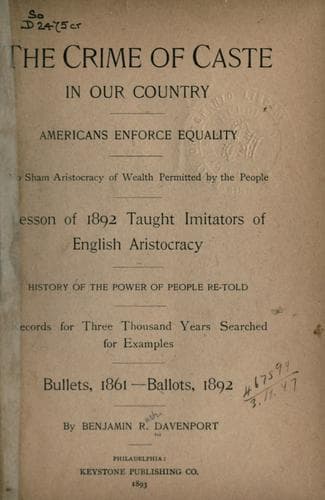
The Crime of Caste in Our CountryDavenport, Benjamin Rush
History
The Crime of Caste in Our Country
Davenport, Benjamin Rush
Social problems; United States -- Social conditions -- 1865-1918
Henry II.’s foolish favoritism to foreigners caused a revolt, under the
leadership of Simon de Montfort, Earl of Leicester, who defeated the
king at Lewes. Earl Simon thereupon called together the Parliament,
summoning, besides the barons, two knights from each county and two
citizens from each city or borough to represent free-holders (1265).
From this beginning, the English Parliament soon took on the form it
has since retained of two assemblies--the House of Lords and the House
of Commons. Thus, the thirteenth century became ever memorable in the
history of the English-speaking people of the world, for the granting
of the Magna-Charta and the forming of the House of Commons--that House
of Commons, which, as its name indicates, was and is made up of the
representatives of the “Common People,” and which has ever been the
bulwark of the liberty of the “Common People” of England, resisting
every attack of autocratic monarchs upon the rights of the people.
In the reign of Edward III. (1327-1377) the Normans and Saxons were
fused completely, and created the English nationality; chivalry
reached its highest exaltation; but the court and the upper classes
were morally rotten. The laboring classes rose during this reign, and
compelled their employers to pay them just wages, and rent to fragments
the despotic edicts that effected them; just as the “Common People”
will ever do, whether the attempt is made to beguile them by the cry of
Protection, Free Trade, Force Bill, or other distracting exclamations.
Richard II. (1377-1399) was a tyrant, with neither the capacity nor
courage of his father and grandfather. He lost all the respect and
admiration with which the people of England had ever regarded his
father and grandfather. One of Richard II.’s tax-gatherers insulted
the daughter of one Watt Tyler, at Dartforth on Kent, in exactly the
same manner as “Chappie” feels at liberty to do, by his glances, the
daughters of the laboring men to-day. Watt Tyler, the wrathful father,
killed the man with one blow, and a formidable revolt sprang at once
into being.
The shouts of about 100,000 “Common People,” gathered on Black Heath,
June 12, 1381, reverberated through the valley of Richard II. The vast
horde poured into London, seized the Tower of London, put to death
the Archbishop of Canterbury and others, and spared the cowering and
cowardly King Richard II., only on his promise to abolish slavery and
grant their demands.
Public-domain text, read in full here on John Shaqi.
Reviews
Reviews
No reviews yet
Be the first to share your thoughts on this work.
Elsewhere in the archive
Join the Discussion
Join the discussion
Sign in to leave a comment or review.
Sign InorCreate an account