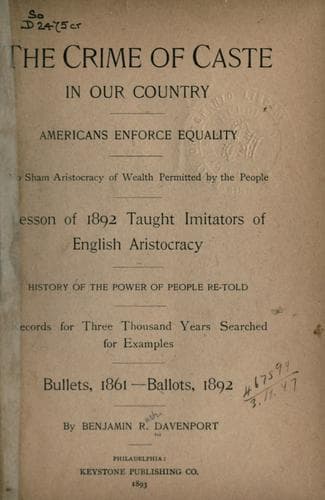
The Crime of Caste in Our CountryDavenport, Benjamin Rush
History
The Crime of Caste in Our Country
Davenport, Benjamin Rush
Social problems; United States -- Social conditions -- 1865-1918
That, my good and would-be lords and barons, is but another evidence
of the Anglo-Saxon blood and its resentment of insult when offered to
the female members of the race. Women ever have occasioned, in the
Anglo-Saxon bosom, just and righteous indignation when insulted. The
slights, sneers, and snubbing of the women of America by the snobs
and sham aristocrats produced the reappearance of the same traits
of character as led Watt Tyler and his horde of peasants to London.
The women of America had become Democratic, and the result of their
influence upon the voters of our country was revealed, November 8th, in
an unmistakable manner.
James I. (1603-1625), the first Stuart to reign in England, was
stubborn, conceited, weak, slovenly, dissipated, and cowardly. In
his reign was first heard the prattle about “the divine right of
kings, and the passive obedience of the subject.” He ostentatiously
opposed his will to that of the people, and during his reign was in
constant conflict with Parliament. He was obliged to beg the House of
Commons for money, and that body adopted the principle, now one of the
cornerstones of the British Constitution, that “a redress of grievances
must precede a granting of supplies.”
Charles I. (1625-1649), the son of James I., was more refined and
held more exalted ideas of his prerogatives; he repeatedly broke his
promises made to the people; his reign was one long struggle with
Parliament.
He was not as frivolous and false as his son Charles II., but James
I., his father, had brought the idiotic doctrine of the divine right
of kings into England along with the rest of his peculiar Stuart
eccentricities,--for eccentric it was to the Anglo-Saxon people,
who had forced from John the Magna-Charta at Runnymede before the
amalgamation of the Norman and Saxon into one homogeneous race had been
completed; who, while there still existed internal dissensions and race
distinction, had been united upon the one great subject for which the
Anglo-Saxon people, best and bravest representatives of the Aryan race,
have ever fought--the equality of man in the representation in the
legislation of the people.
Public-domain text, read in full here on John Shaqi.
Reviews
Reviews
No reviews yet
Be the first to share your thoughts on this work.
Elsewhere in the archive
Join the Discussion
Join the discussion
Sign in to leave a comment or review.
Sign InorCreate an account