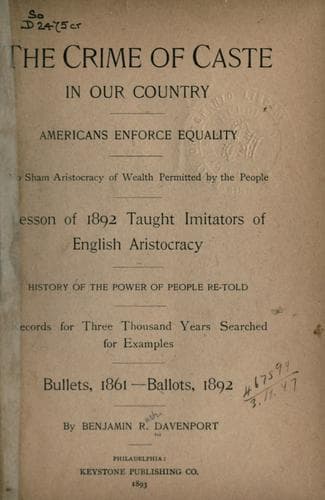
The Crime of Caste in Our CountryDavenport, Benjamin Rush
History
The Crime of Caste in Our Country
Davenport, Benjamin Rush
Social problems; United States -- Social conditions -- 1865-1918
Strange to the ear of the masses was the doctrine of the Stuart, that
the king was one of the Lord’s anointed and could do no wrong. They
had seen kings do wrong when cursed with a wrong-doer as king, and
supported any aspirant to the crown of England, no matter how slender
may have been the thread of his claim thereto. Richard II. had played
the autocratic ruler. Englishmen had resisted by espousing the cause of
the first claimant who appeared upon the field. The assumption by the
Stuarts of a divine right was the first stab that they gave to their
own existence as the ruling House of an Anglo-Saxon people. Charles I.
reaped where James I. had sown. The English people had forgiven before
the bad faith of their sovereign, as they have since. They have endured
the waste of their money because the Anglo-Saxon, whence we Americans
derive the source of blood and laws, has not his tender spot upon the
pocketbook, but in his heart, his home, his pride, believing himself,
each man, equal to any other man.
In 1628, Parliament wrested from Charles I. the famous Petition of
Rights, the second great charter of English liberty. It forbade the
kings to levy taxes without the consent of Parliament, to imprison a
subject without trial, or to billet soldiers in private houses. As
usual, Charles disregarded his promises, and then for eleven years
ruled like an autocrat.
During that period no Parliament was convoked, a thing unparalleled
in English history. Buckingham having been assassinated by a Puritan
fanatic, the Earl of Stafford and Archbishop Laud became its royal
advisers. The Earl contrived a plan for making the king absolute. All
who differed from Laud were tried in the High Commissioner’s Court,
while the Star Chamber Court fined, whipped, and imprisoned those
who spoke ill of the king’s policy or refused to pay the money he
illegally demanded. The bitter persecution of the Puritans drove them
to America. In Scotland, Charles carried matters with a high hand.
Laud attempted to abolish Presbyterianism and introduce a liturgy. The
Scotch rose _en masse_, and signed (some of them with their own blood)
a covenant binding themselves to resist every innovation directed
against their religious rights. Finally, an army of Scots crossed the
border into England, and Charles was forced to assemble the famous
“Long Parliament” (1640), which lasted twenty years. The old battle
was renewed. Stafford, and afterward Laud, were brought to the block;
the Star Chamber and High Commissioners’ Courts were abolished, and
Parliament voted that it could not be adjourned without its own
consent. Charles attempted to arrest five of the leaders of Parliament
in the House of Commons itself. They hid in the City of London, whence
a week later they were brought back to the House of Commons in
triumph. Charles hastened Northward, and unfurled the royal banner. For
a time his supporters swept everything before them.
Public-domain text, read in full here on John Shaqi.
Reviews
Reviews
No reviews yet
Be the first to share your thoughts on this work.
Elsewhere in the archive
Join the Discussion
Join the discussion
Sign in to leave a comment or review.
Sign InorCreate an account