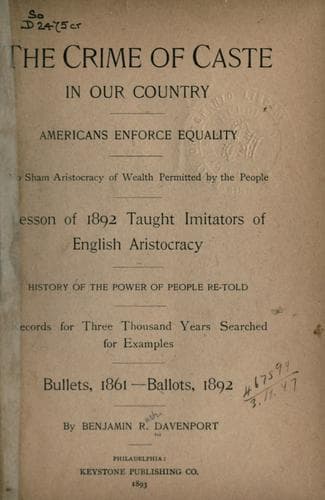
The Crime of Caste in Our CountryDavenport, Benjamin Rush
History
The Crime of Caste in Our Country
Davenport, Benjamin Rush
Social problems; United States -- Social conditions -- 1865-1918
Then arose Oliver Cromwell, a man of the “Common People,” who, with
his Ironsides regiment at Marston Moor (1644), drove the cavaliers
pell-mell from the field. Nasby (1645) was the decisive contest of the
war. Cromwell swept the field, and the royal cause was irrevocably
lost. Charles fled to the Scots, who gave him up to the Parliament; but
the army of the “Common People,” led by Cromwell, soon got him into its
possession, and he was condemned to death on the charge of treason, and
was beheaded.
Thus, as has ever been the case when the “Common People” have been
goaded by insult into a furious state of temper, some leader has aptly
sprung, like Cromwell, from their ranks, and carried them triumphantly
to victory. In the same way George Washington, Thomas Jefferson, Andrew
Jackson, Abraham Lincoln, and Grover Cleveland have each in turn led
the hosts of the “Common People” to victory in their battles against
“divine rights,” injustice, “caste,” and “sham aristocracy.”
England, by the execution of Charles I., was without a king. The
authority was vested in the House of Commons (diminished by Pride’s
Purge the expulsion of the Presbyterian minister) contemptuously styled
“the Rump.” Cromwell, the man of the “Common People,” and his terrible
army, composed of the “Common People,” were the actual rulers. In
Ireland and Scotland the Prince of Wales was proclaimed as Charles II.,
whereupon the grim Ironsides--those representatives of the people, and
their terrific earnestness when aroused--conquered Ireland as it never
was conquered before. Crossing then to Scotland, the covenanters were
routed at Dunbar, and again at Worcester.
Cromwell, while he had the power of a king, like Cæsar, dared not
take the title. He recognized, what it would be well for the sham
aristocrats to attentively regard, that the people MAKE and UNMAKE;
hence, he did not dare offend the “Common People” by assuming the title
of king, though exercising all the powers of a king. Under Cromwell,
England’s glory became greater than under Elizabeth. The Barbarian
pirates were punished; Jamaica was captured; Dunkirk was received from
France in return for help against Spain; protecting the Protestants
everywhere, Cromwell compelled the Duke of Savoy to cease persecuting
the Baudois. The very name of England became terrible to the oppressor
of the poor in every land. The people, in their might, were ruling
England; because, even though Cromwell was styled “Lord Protector of
the Commonwealth,” he still understood that his greatest power rested
upon the will of the “Common People” as a foundation.
Public-domain text, read in full here on John Shaqi.
Reviews
Reviews
No reviews yet
Be the first to share your thoughts on this work.
Elsewhere in the archive
Join the Discussion
Join the discussion
Sign in to leave a comment or review.
Sign InorCreate an account