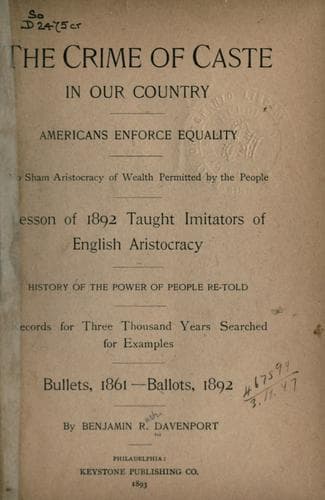
The Crime of Caste in Our CountryDavenport, Benjamin Rush
History
The Crime of Caste in Our Country
Davenport, Benjamin Rush
Social problems; United States -- Social conditions -- 1865-1918
Upon the death of Oliver Cromwell there was no hand strong enough to
seize the helm of the ship of State. His son Richard, who did not
inherit the genius of his father, and did not hold the confidence of
the “Common People” of England, was quickly put aside. And the English
people--the “Common People”--casting about for an executive to place
at the head of the nation, selected Charles II., whom they called to
England to rule them, but not “by divine right;” simply as their king.
The popularity of Charles II., the most profligate, the most licentious
and immoral ruler that Great Britain has ever had, arose because he was
the people’s king. They had called him from over the sea; he ruled by
no divine right, but through the affections of the people. He was to
them _their_ king, and though he sinned, erred, and wasted the money of
the nation, he was _of_ the people, and they forgave him. When James
II. attempted to revive (as the people feared he would, and hated him
in consequence, even before his succeeding Charles II.) “the divine
right of kings,” and the privilege of doing anything, the idea that
nothing that he did could be wrong, the people resented it. It was not
Catholicism. Dear as religion may be in the heart of man, there is one
thought that is dearer: it is his right to be a man, and equal to any
other. Had James II. been a people’s man, as was Charles, his brother,
it is quite possible that the House of Stuart might now reign in Great
Britain. William of Orange was beloved by the people, because he was so
thoroughly a people’s man, that even the proud Anglo-Saxons preferred
to submit themselves to his rule, joined with a daughter of the House
of Stuart, rather than to the legitimate successor of Charles II. The
mighty voice of the people was heard resounding in the selection of
the Prince of Orange with the same notes that marked the music of the
march of a triumphant Democracy, on November 8, 1892; like the grains
of wheat taken from the tombs of the Pharaohs, though gathered in a
harvest of fifty centuries ago, when planted will produce the same crop
as to-day.
History repeats itself continually, and nowhere more obvious is the
repetition than in the record of the Anglo-Saxon race. The same causes
which occasioned the unpopularity of Charles I., the popularity of
Cromwell, the popularity of Charles II., were working to create
Cleveland’s tremendous popularity and the overthrow of the Republican
party November 8, 1892.
CHAPTER XVI.
THE GERMAN EMPIRE, 1520-1525.
Public-domain text, read in full here on John Shaqi.
Reviews
Reviews
No reviews yet
Be the first to share your thoughts on this work.
Elsewhere in the archive
Join the Discussion
Join the discussion
Sign in to leave a comment or review.
Sign InorCreate an account