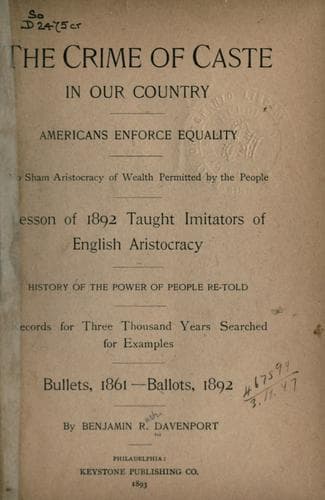
The Crime of Caste in Our CountryDavenport, Benjamin Rush
History
The Crime of Caste in Our Country
Davenport, Benjamin Rush
Social problems; United States -- Social conditions -- 1865-1918
Germany does not present a fruitful field for examples of popular
uprisings and the exhibition of the indignation of the people when
crushed by the oppressors of the upper classes. Germany to-day, even
in the last decade of the nineteenth century, presents a picture of
the only government in Europe which pretends to have a representative
form of government, where the chief executive, the Emperor, can speak
of himself, or would dare to do so, as the “war lord,” to whom absolute
obedience is due by the citizens of the Empire. The Anglo-Saxons,
while a branch of the great Teutonic race, seem to have acquired, by
their being transplanted to the British Isles, a greater spirit of
independence than the other branches of the German race that have
remained on the continent of Europe.
Otho I., son of Henry I., the mighty Saxon duke, was the founder of
the German empire (936-973), and remorselessly crushed the rising
opposition of the princely aristocracy. Mutterings of discontent,
ominous of coming revolution, began to be heard throughout the whole
of South and Central Germany, in the early years of the seventeenth
century. The social position of the peasants was of the most degrading
character. They were serfs; or, in other words, belonged to the soil on
which they were born, and through that to the lord who owned the soil.
The miserable peasants had no right to move from these lands; there was
no appeal from the authority of the lord. When he appropriated for his
own use the common pasture grounds of the village; when he forbade them
to fish in the streams, or to hunt in the woods; increased the ground
rent; tithe socage service, according to his own need, they had to
submit or revolt.
Thomas Münzer was an earnest, advanced preacher at Zwichfau, in Saxony,
in 1520 and in 1523. He was expelled from Allstadt by the government,
and went first to Nuremberg, and then to Schaffhausen, returning
soon to Thüringia, and settled at Mülhausen. There he succeeded
in overthrowing the city council and appointing another which was
completely under his control.
Götz von Berlichingen was a famous German knight, surnamed “The Iron
Hand.” He was born in 1480, at Berlichingen Castle, in Wurtemberg. He
lost a hand at the siege of Land Shut, and replaced it with an iron
one. He was a daring and turbulent subject, continually involved in
feuds with neighboring barons.
Thomas Münzer and Götz von Berlichingen were the only leaders who took
part in what is known as “The Peasants’ War,” in Germany. This was
an uprising of the peasants, which first manifested itself January
1, 1525, by the capture and looting of the convent of Kempton. This
served as a signal for general uprising of the peasantry from the Alps
to Havz, and from the Rhine to the Bohemian frontier. Münzer quickly
persuaded the whole population in and around Mühausen and Laugensalza
to rise in revolt, and Götz von Berlichingen hastened to place his
skill at the service of the infuriated peasants.
Public-domain text, read in full here on John Shaqi.
Reviews
Reviews
No reviews yet
Be the first to share your thoughts on this work.
Elsewhere in the archive
Join the Discussion
Join the discussion
Sign in to leave a comment or review.
Sign InorCreate an account