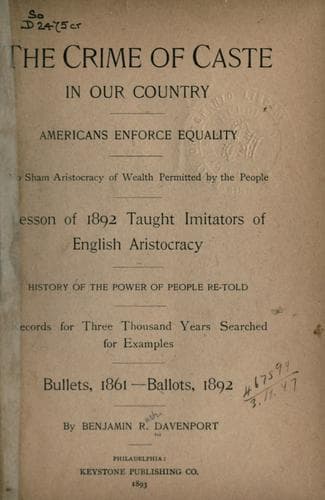
The Crime of Caste in Our CountryDavenport, Benjamin Rush
History
The Crime of Caste in Our Country
Davenport, Benjamin Rush
Social problems; United States -- Social conditions -- 1865-1918
The occurrence created great excitement among the Plebeians, and
would have provoked an outbreak had not messengers entered the city
bearing the news that a Volucian army was marching to attack Rome.
With their stern sense of patriotic duty, the disaffected citizens
prepared to meet the foe, it being promised that their wrongs should be
investigated after the war. They met and defeated the enemy, but the
promise of the Patricians was not kept.
In despair of obtaining justice, the Plebeians decided to secede from
the Commonwealth and to found a city on the Sacred Hill, three miles
from Rome. This brought the Patricians to terms. Rather than lose
the working force of the community, they agreed to release all those
enslaved for debt, and to authorize the appointment of magistrates,
called Tribunes, who should be chosen from the Plebeians, and should
have the right of forbidding any act of oppression.
From that beginning the Plebeians advanced to full political and social
enfranchisement, after a struggle that lasted for two centuries--a
stern and bitter struggle, although it was waged “with a perseverance,
forbearance, and moderation, of which there is scarcely a parallel
in the history of the world.”[3] The next step was a law to compel
the Patricians to pay rent for the public land they occupied. It was
disregarded, and the Tribune Genucius, who attempted to enforce it, was
murdered. Then by mutual agreement a body of commissioners (Decemvirs)
was appointed to draw up a revised code of laws for all classes. Again
the Plebeians had been deceived; the commissioners seized the executive
power, and held it illegally and tyrannously until the Commons ended
their usurpation by a second secession to the Sacred Hill.
The agrarian question remained a burning one until the Tribunes
Licinius and Sextius forced a settlement of it by stopping the whole
machinery of government until their propositions were accepted. The
procedure was constitutional, but for ten years (376 to 366 B. C.)
Rome was in a state of anarchy, and the fact that actual civil war was
avoided testifies strongly to Roman self-restraint.
The legislative power was now the only one denied to the Plebeians.
The Publican law was passed to give it to them, but the Patricians
prevented its enforcement until by a third secession the Commons again
carried their point, and at last secured final and complete equality
between the classes. (286 B. C.)
Rome, once the mistress of the world, retained her grandeur only so
long as the principles of true democracy pulsated through her body
politic and nerved her every action. When prosperity, corruption, and
abuse blinded the rulers to the claims of the Plebeians, then came
revolution, civil war, decline, and finally the fall of the proudest
empire known in the history of man.
Public-domain text, read in full here on John Shaqi.
Reviews
Reviews
No reviews yet
Be the first to share your thoughts on this work.
Elsewhere in the archive
Join the Discussion
Join the discussion
Sign in to leave a comment or review.
Sign InorCreate an account