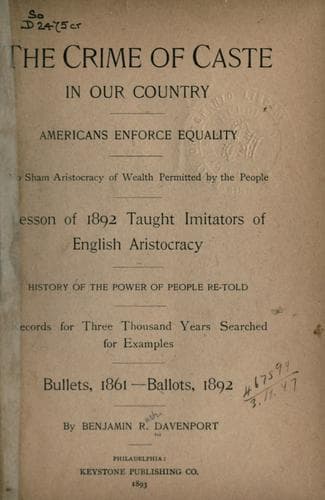
The Crime of Caste in Our CountryDavenport, Benjamin Rush
History
The Crime of Caste in Our Country
Davenport, Benjamin Rush
Social problems; United States -- Social conditions -- 1865-1918
So, the mightiest empire the world ever knew declined and fell before
the power of the PEOPLE, who, outraged in their most sacred rights,
revolted again and again, until, as may be said, the fabric, whose
shadow reached to the uttermost ends of the earth, was torn asunder,
and so went to fragments that not one stone was left upon another.
FOOTNOTE:
[3] Dr. Schmidtz’s History of Rome.
CHAPTER XX.
GREECE--VENICE--THE RULE OF “CASTE.”
Although ancient Greece was divided into many small countries, yet they
were united by bonds of union, of community, of blood and language, of
religious rites and festivals, manners and character. In these respects
they were distinguished from all other people, whom they called
barbarians.
A thousand years before the Christian era the Greeks were divided into
the nobles, who were powerful and wealthy; the freemen, some of whom
owned estates; and the slaves.
But the manners of the highest class were simple. The nobles were proud
of their skill in the manual arts, and their wives and daughters ably
discharged their household duties.
Two hundred years later (B.C. 800) most of the states and cities of
Greece became democratic. One uniform method characterized the change
from monarchy to democracy. An oligarchy of nobles would overthrow the
monarchy, and then some one noble would overthrow the oligarchy and
establish the cause of the people.
Sparta was the highest type of oligarchy; Athens of democracy.
Ever since Aristotle distinguished them, there have been three
recognized types of government--monarchy, oligarchy, and democracy--the
rule of one man, the rule of a few men, and the rule of the people.
That the last is the just and the true form of polity, the enlightened
opinion of the world has long ago irrevocably decided. Of the other
two, experience shows that monarchy is more tolerable. A Nero may
have stained the pages of history by the diabolic cruelty to which
autocratic power gave free scope; a Napoleon may have poured out half
the life-blood of his country to further his selfish personal ambition;
yet, on the whole, the evils of one man’s rule have been more endurable
than those of the domination of a class or “caste.” In latter days
the sovereign has come to be looked upon less as a personal ruler
than as an abstraction--an embodiment of theory expressed in the old
maxim that “the king can do no wrong”--a conception far less offensive
to the innate democracy of all manly peoples; or, he is regarded as
a mere figure-head, as may be said to be the case is England, whose
nominal monarch has far less practical influence upon the executive and
legislative departments than has the President of the United States.
An oligarchy is the worst of all governmental systems. It has never
made a people truly great. Wherever such a government has existed its
record has almost always been dark and its end bloody.
Public-domain text, read in full here on John Shaqi.
Reviews
Reviews
No reviews yet
Be the first to share your thoughts on this work.
Elsewhere in the archive
Join the Discussion
Join the discussion
Sign in to leave a comment or review.
Sign InorCreate an account