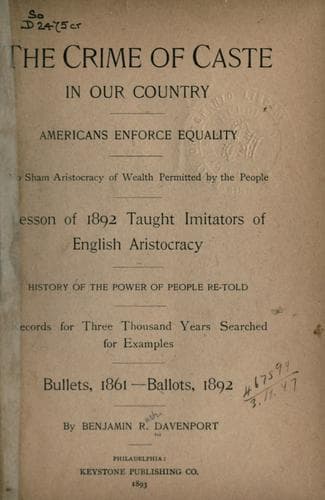
The Crime of Caste in Our CountryDavenport, Benjamin Rush
History
The Crime of Caste in Our Country
Davenport, Benjamin Rush
Social problems; United States -- Social conditions -- 1865-1918
Look, for example, at two of the most successful oligarchies of
history--ancient Sparta and mediæval Venice. Sparta was, as Bulwer
justly observes in his “Rise and Fall of Athens,” a “machine wound
up by the tyranny of a fixed principle, which did not permit it even
to dine as it pleased; its children were not its own--itself had no
property in self. So it flourished and decayed, bequeathing to fame
men only noted for hardy valor, fanatical patriotism, and profound but
dishonorable craft--attracting, indeed, the wonder of the world, but
advancing no claim to its gratitude and contributing no single addition
to its intellectual stores.”
Such was the state that was ruled by the privileged “caste” of the
Spartans and its administrative committee, the Ephoræ--a state
remembered only for its brief military supremacy over her Grecian
neighbors. Contrast her with one of those neighbors--Athens, the most
typical and the most democratic of ancient democracies.[4] “The people
of Athens,” says Bulwer, “were not, as in Sparta, the tools of the
state--they were the state! In Athens the true blessing of freedom
was rightly placed in the opinions and the soul. This unshackled
liberty had its convulsions and its excesses, but it produced masterly
philosophy, sublime poetry, and accomplished art with the energy and
splendor of unexampled intelligence. Looking round us, more than four
and twenty centuries after, in the establishment of the American
Constitution, we yet behold the imperishable blessings which we derive
from the liberties of Athens. Her life became extinct, but her soul
transfused itself, immortal and immortalizing, throughout the world.”
Venice was another such oligarchy as Sparta--ruled by a small patrician
“caste,” who chose an all-powerful Senate from their own number; and
from the Senate was selected an Executive Council of Three--a name that
has become proverbial for a body of secret and irresponsible tyrants.
Venice’s strength was in commerce, in finance, as Sparta’s was in war.
Her rich trade with the East and West made her seem
The pleasant place of all festivity,
The revel of the earth, the masque of Italy.[5]
But her internal government was one long reign of terror. The Council
of Three met at night, masked and robed in scarlet cloaks, to judge
those against whom accusations had been thrust into the yawning “Lions’
Mouths”--two slots in the wall into which any might thrust an anonymous
denunciation of his enemy. And from the Council’s sentence there was no
hope of appeal; its victims were hurried across the Bridge of Sighs to
vanish forever from human sight in the awful torture chambers to which
that melancholy passage led.
Public-domain text, read in full here on John Shaqi.
Reviews
Reviews
No reviews yet
Be the first to share your thoughts on this work.
Elsewhere in the archive
Join the Discussion
Join the discussion
Sign in to leave a comment or review.
Sign InorCreate an account