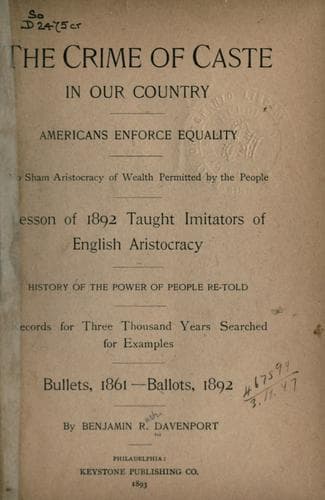
The Crime of Caste in Our CountryDavenport, Benjamin Rush
History
The Crime of Caste in Our Country
Davenport, Benjamin Rush
Social problems; United States -- Social conditions -- 1865-1918
It was not a great summer and
autumn for brass bands and torches. It was not a great year for
newspapers. Those that largely increased their circulation did it
outside of presidential excitements and political attractions. The
second surprise was the immense registration. Then it was seen
that comparative public quietude did not mean lack of interest.
Everybody knew something was going to happen. Republicans were
cheered, and said: ‘This means the quiet vote. The secret ballot
is with us. Times are good. There’ll be a big vote, on the quiet,
to let well enough alone. Harrison is a great President, and it
is the will of the people that he shall continue his good works.’
The Democrats said: ‘The secret ballot is with us this time.
The workingman is dissatisfied. He gets more wages than he does
abroad, but he holds that he is robbed of his share of the riches
of the land, and the quiet vote is with us. The workshops are
for a change.’ There was much in what they said. The workingmen
gave the Democrats New York, New Jersey, Connecticut, Indiana,
Illinois, and the election; but was there ever such a combination
of antagonisms gathered into an opposition force, to carry the
Government by storm, as that which the Democracy was enabled
to make? Contrast the Democratic platforms of Connecticut and
Kentucky. They are more flagrantly opposed to each other than the
Minneapolis and Chicago papers. Connecticut is rankly Protection,
and Kentucky rabidly Free Trade. Both are for freedom. The
Democrats joined with the Populists in several States to give
Weaver votes, and in other States terrorized, threatened,
assaulted, and cheated his opponents.
“Take the money matters; we find the Democracy are red dog, wild
cat, rag baby, silver pig, or gold bug, according to the local
demands. They are all for Cleveland, however. The very ferocity
of the personal factions of the Democratic party in New York
was converted into steam power to drive the Cleveland machine.
There was emulation in his service, between his old friends and
enemies; and the enemies of other days exceeded the friends in
the competitive struggle. The Democrats who hoped he would be
defeated, and there were many thousands of them, were the most
particular of men to vote for him because they felt their future
in the party depended upon their ‘record.’ What they wanted was to
be beaten in the ‘give-a-way game,’ and they trusted to the last
to be able to say: ‘There, you see how it is; we told you he was
impossible. We’ve done all we could, and it is just as we said.’
Public-domain text, read in full here on John Shaqi.
Reviews
Reviews
No reviews yet
Be the first to share your thoughts on this work.
Join the Discussion
Join the discussion
Sign in to leave a comment or review.
Sign InorCreate an account