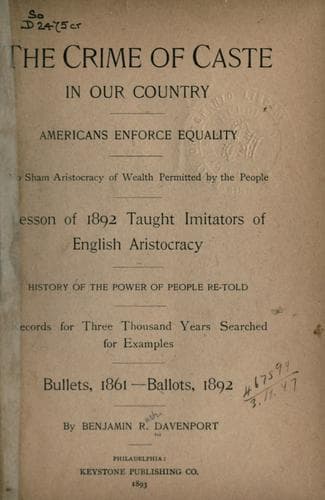
The Crime of Caste in Our CountryDavenport, Benjamin Rush
History
The Crime of Caste in Our Country
Davenport, Benjamin Rush
Social problems; United States -- Social conditions -- 1865-1918
said, they once hitched canoes to walnut trees away above the ’32
mark; but them Indians was such liars.’ The flood of 1885 beat
that of 1832 two feet, and the flood of 1887 was nearly seven feet
above the old high-water-mark. Averaging the chances, it will not
happen again for one hundred years. The river Rhine has a way of
rising at the same time with the Ohio, and was higher in 1885
than it had been in two hundred years. There was favoring the
Democratic party this year, such a combination of circumstances as
that which made an Ohio flood seem a prodigy. The high-water-mark
is astounding. The country is still here. There is something to
eat, and even to drink. Such a Democratic disaster will not be due
again for a generation.”
John Russell Young, the brilliant journalist, writing in the
Philadelphia _Evening Star_, quoted by the New York _Press_, of
November 19th, has his explanation for the defeat ready: “Communities
are like men, like women, like children, like dogs. Why do they do it?
Why does a man buy wildcat stocks? Why does a woman rave over a bonnet,
or marry a student of divinity? Why? Because we are more or less fools,
even as the good Lord made us fools, and if we were not fools, it would
be a teasing, tiresome world. Why does a boy go to bed as cross as
the roaring forties after his Christmas dinner? He has had too much
mince pie. The country has had too much mince pie. It kicks. It kicked
after Quincy Adams, the best of all Presidents. It kicked after Van
Buren, who was as downy as an Angora cat. It kicked after Arthur, whose
administration was sunshine. It kicks after Harrison, the radiant,
prosperous Government. Too much mince pie! Cleveland comes in because
of his medicinal properties. We must take to our herbs now and then.”
The practical politicians of the Republican party feel it incumbent
upon them to give their version of the great defeat. James S.
Clarkson, who, for many years, has been a guiding spirit among
Republican leaders, of the late verdict says: “It is an order from the
American people for a change in the industrial economic policy of the
Government.” He charges that the Republican party has lost strength
and votes among the rich and among the people of independent means,
who now want cheap labor; also among the workingmen, who have come to
believe that free trade will cheapen the expense of living, while the
Trades-Unions will still keep up their wages. He says: “The result is
not a personal defeat of President Harrison, nor really a defeat of
the party. It was a Protection defeat, a repudiation of high tariff, a
Republican reverse in a field where it put aside all the nobler issues,
and staked everything on economic and mercenary issues.”
Public-domain text, read in full here on John Shaqi.
Reviews
Reviews
No reviews yet
Be the first to share your thoughts on this work.
Join the Discussion
Join the discussion
Sign in to leave a comment or review.
Sign InorCreate an account