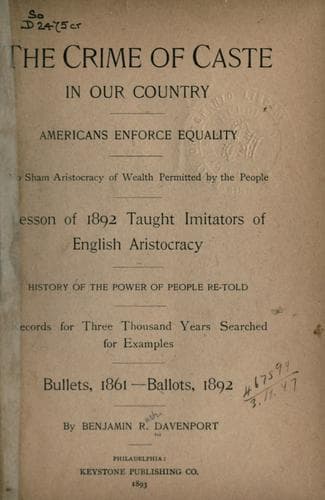
The Crime of Caste in Our CountryDavenport, Benjamin Rush
History
The Crime of Caste in Our Country
Davenport, Benjamin Rush
Social problems; United States -- Social conditions -- 1865-1918
“‘High tariff did it,’ said Mr. Harrison; but in taking satisfaction
for his defeat out of the Napoleonic McKinley, the President is less
than just to the magnetic Blaine; for, if high tariff caused the
explosion, despite the ‘reciprocity attachment,’ what might it not
have done without that little Pan-American vent-hole?” This from the
Philadelphia _Record_.
The President, had he combined the magnetism of Blaine, the Napoleonic
ability of McKinley,--yea, had he, in fact, borne the magical name of
Lincoln,--could not possibly have been re-elected, for the people were
opposed to the ideas of “caste,” fostered with such care by the members
of the Republican party, in whom, in some mystical manner, have become
concentrated the wealth and objectionable characteristics which tended
to make the Southern cavalier so unpopular in 1860. The people, in
their wrath, would have risen against any party so besmeared with the
slime of that noxious crime.
The Atlanta _Constitution_, of November 17th, claims that “the leaders
of the two great parties have had a good deal to say during the past
few months about ‘the campaign of education.’ In the main, this
phrase very correctly describes the work of both parties. Republican
speakers and journalists work night and day to convince the people
of the benefits of high Protection. On the other hand, the Democrats
are equally active in exposing the true inwardness of McKinleyism and
class legislation. This educational literature covered the country,
and the average voter got a clearer insight of the questions at issue
than he ever had before. One effort of this campaign of education was
to eliminate personalities; principles and measures were discussed,
and the candidates escaped the usual mudslinging. Another result is
seen in the sweeping and decisive nature of the vote. The revolution
was so complete that the defeated side realized the utter absurdity
of indulging in any bitter complaints, with the great mass of American
people arrayed against them. Our victory was so crushing, that it
absolutely restored something like good feeling; and we find Whitelaw
Reid and Chauncey Depew saying pleasant things to Mr. Cleveland at a
banquet, and speaking of their defeat in a humorous fashion. This would
not have been the case, had the election been close and only a bare
majority of electoral votes for the successful ticket. Altogether, the
country has good reason to be satisfied with its campaign of education.
It has purified our politics, wiped out sectional lines, and made our
people more thoroughly American than ever.”
Public-domain text, read in full here on John Shaqi.
Reviews
Reviews
No reviews yet
Be the first to share your thoughts on this work.
Join the Discussion
Join the discussion
Sign in to leave a comment or review.
Sign InorCreate an account