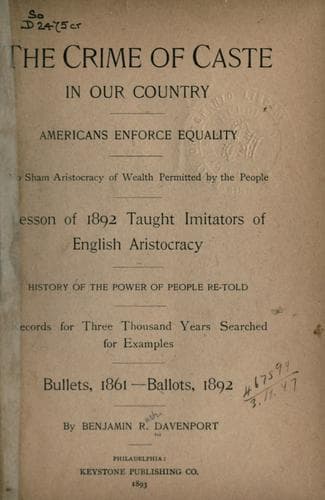
The Crime of Caste in Our CountryDavenport, Benjamin Rush
History
The Crime of Caste in Our Country
Davenport, Benjamin Rush
Social problems; United States -- Social conditions -- 1865-1918
And for the erasure of sectionalism, God be thanked! but that a man of
Mr. Clark Howell’s preëminent ability should have wandered around so
near to the object of his search, the cause of the Republican party’s
defeat, and not found it, is astonishing. In his own home, the State of
Georgia, the Empire State of the South, and as editor of the leading
paper in the State, that he should be so oblivious to the fact that
the election, by the votes of the people, was a protest upon the part
of the people against the assumption by the rich, that such a thing as
“caste” could be possible in America.
Georgia, of all the Southern States, is preëminently industrial.
Oglethorpe, when he first settled on the banks of the Savannah river,
was himself surrounded by the poor debtors of England. The Salzburgers,
who sought the shores of the uninhabited, uncivilized, new colony, were
poor, uncultured people. Georgia never possessed, as a colony or as a
State, the aristocratic tendencies of its neighbor, South Carolina. The
foremost men have ever been essentially of the people; her settlers
largely of the Democratic masses; the names preëminent in her history
are the names of industrial New England. So Democratic is and was the
State of Georgia, that her most eminent son, Alexander H. Stevens,
had to be weaned away reluctantly from the doctrine of which Abraham
Lincoln was the personification. Since the war, the State of Georgia
more readily adapted herself to the new condition created by the result
of the struggle. It was never a State of tremendous landed proprietors.
The influx of emigration from the crowded Northern States found readier
assimilation in the State of Georgia than in any other Southern
State. In that State, the negro sooner realized his responsibilities
as a citizen of the South, sooner became convinced that his best and
wisest course was to merge himself into the large class of toilers and
laborers in the commonwealth. That a man with the opportunity, ability,
and brilliancy of Clark Howell, should become so utterly befogged by
the mists arising from the marsh of old party cries and principles,
should fail to recognize that the tremendous majority accorded the
Democratic candidate, was but an exhibition of that spirit which has
pervaded the State of Georgia from its embryonic existence on the
Savannah river; that Mr. Howell should have forgotten the lesson taught
by the forefathers of the Georgians of to-day, that Democracy was one
of the essential elements to the happiness of the citizens, settlement,
colony, commonwealth, and State, is passing strange. The very negro,
upon becoming a Georgian and a citizen, became a Democrat, almost as
a matter resulting from the atmosphere he breathed. Georgia’s vast
majority for the Democratic nominee was not rolled up except by the
aid of the negro, who, in his heart of hearts, is a Democrat, and the
appeals of the Republican party to his gratitude, claiming that they
Public-domain text, read in full here on John Shaqi.
Reviews
Reviews
No reviews yet
Be the first to share your thoughts on this work.
Join the Discussion
Join the discussion
Sign in to leave a comment or review.
Sign InorCreate an account