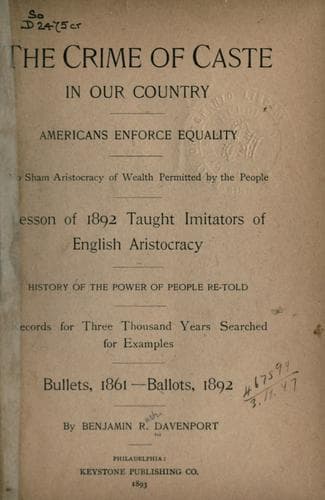
The Crime of Caste in Our CountryDavenport, Benjamin Rush
History
The Crime of Caste in Our Country
Davenport, Benjamin Rush
Social problems; United States -- Social conditions -- 1865-1918
who voted for him because he was associated with their idolized free
trade candidate, would have only themselves to thank for the prospect
of disaster and panic they might face. They would then pay the penalty
of their reckless inconsideration. Protection for American homes, for
American workingmen and American farmers, an honest dollar for honest
men, and a policy of free trade extension by the beneficent influences
of reciprocity, may all suffer assaults in the four years to come,
but we can trust the sober, second judgment of the American people,
in the light of another but recent experience with the free trade and
fraudulent silver Democracy, to do again in 1896 what it did with that
party at the close of the first Cleveland experiment, and turn the
incompetents out.”
It _is_ most extraordinary and unusual for the American people to seek
a change in the administration at a time of unwonted prosperity, but
the inward agitation of soul at the thought of great wrongs committed
by a pretended beneficent party led to the revolution of ’92, in very
much the same manner as inward agitation on another subject brought
about that which placed Abraham Lincoln in the Presidential Chair. The
American workman is above the American dollar!
The New York _World_, in an editorial of November 16th, says: “The
_Iron Trade Review_ is putting the manufacturers up to a dodge in order
to make the people sorry that they voted for Mr. Cleveland. Its advice
is that the manufacturers reduce the wages of their workingmen ‘to
fortify themselves in advance in view of the increasing probabilities
of destructive foreign competition.’ Is this an indication of
the kindly feeling entertained by the Protectionists for their
workingmen? They have professed that their tax policy was maintained
for the purpose of increasing wages. They have been charged with
misrepresentation; and they are now advised by one of their organs to
prove that the charge is true, by making the wage-earners suffer in
order that revenue reform may become unpopular. Nothing could better
show the dishonesty of the Protection claim that the tariff exists for
the workingman. If that claim were true, the manufacturers would resist
every tendency toward downward wages, instead of pushing them down in
order to gain an advantage for themselves in a political controversy.
The wages of labor are regulated by the supply and demand of the labor
market, and the people who would cut down wages, not because they must,
but because they want to revenge themselves for a Democratic victory by
making the workingman suffer, are the people who have been insisting
that the McKinley law repealed the law of supply and demand, and that
they are the true and unselfish benefactors of the workingmen. Happily,
the next President is a Democrat.”
[Illustration: General JAMES B. WEAVER.
Presidential Candidate of the People’s Party, 1892.]
CHAPTER II.
THE ALLEGED GENERAL DISCONTENT.
Public-domain text, read in full here on John Shaqi.
Reviews
Reviews
No reviews yet
Be the first to share your thoughts on this work.
Join the Discussion
Join the discussion
Sign in to leave a comment or review.
Sign InorCreate an account