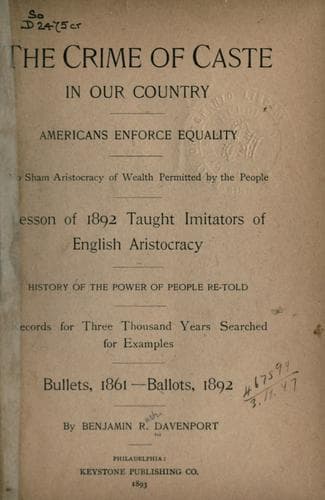
The Crime of Caste in Our CountryDavenport, Benjamin Rush
History
The Crime of Caste in Our Country
Davenport, Benjamin Rush
Social problems; United States -- Social conditions -- 1865-1918
The workmen of our country, it is true, want better times, cheaper
clothing, the doing away with trusts, and many other desirable changes;
but far more than this, they feel the need of the absolute crushing
out of the last vestige of “caste.” They at last realize that “caste”
is a crime; and the common people have, at heart, no sympathy with
criminals, and especially criminals of that class. The common people
stay at home, work hard, and very seldom have need to “go to Canada,”
or take a flying trip to Southern Europe. Their sins are mainly
those of passion. At their best, they are kindly disposed to their
fellows; but they are _human_. They feel a snub from their employer
or employer’s son as keenly as their honest, hard-working wives and
daughters feel the haughty stare and condescending patronage of Madame
Crœsus and her bejewelled daughters. Here we offer our readers some
explanations, given by the common, average American citizen, for the
defeat of the Republican party at the polls on November 5th. The
article is taken from the pages of the New York _Tribune_, November
21, 1892, the official organ of the Republican Vice-Presidential
candidate, and therefore entitled to more than ordinary consideration.
The article is headed “The General Discontent.”
It consists of talks with the people about the recent election in
New York State and Vermont. It is, largely, the observations of a
correspondent who has walked through the State, asking farmers and
workingmen why they voted for Cleveland. Let it not be forgotten that
Whitelaw Reid is the editor of this paper.
Public-domain text, read in full here on John Shaqi.
Reviews
Reviews
No reviews yet
Be the first to share your thoughts on this work.
Join the Discussion
Join the discussion
Sign in to leave a comment or review.
Sign InorCreate an account