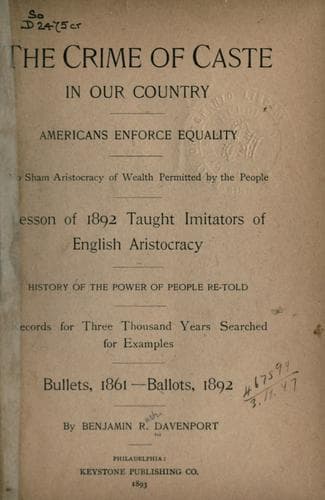
The Crime of Caste in Our CountryDavenport, Benjamin Rush
History
The Crime of Caste in Our Country
Davenport, Benjamin Rush
Social problems; United States -- Social conditions -- 1865-1918
It was not any one nor all of these causes that moved the people. Each
newspaper, Democratic or Republican, has selected some nail upon which
it hangs the laurel wreath of victory, inscribed with its own puny text
for which it has fought its little battle, and each newspaper of the
Republican press has covered, with the tattered garments of defeat, its
little text wherein it had proclaimed that the Republican party would
be victorious, and labeled its tattered garment of lack of judgment
with some phrase like, “Disloyalty of Platt,” “Incapacity of Carter,”
“Want of Organization,” “Lack of Popularity and Magnetism of our
Candidate,” “The Voters didn’t come out.” Had the press no part of its
own reputation at stake, they would have searched and delved into the
bosoms of men; yes, neither space nor distance, time nor expense, would
have been spared by the magnates of the newspaper world to ascertain
the true cause. But in ascertaining that true cause, it would have been
necessary, in announcing the same, to stultify themselves in what they
had been predicting, proclaiming, foretelling, and advising, for months
and years.
The truth is in the air; was in the air before the election. ’Twas
breathed; it was thought; yea, better, it was _felt_, by the
great throbbing, aching heart of the men and women of the Union.
From the hovel to the palace, the insidious, poisonous vapor of a
supposed affected, sham aristocracy, with the noxious slime of a
half-proclaimed doctrine of the inequality of man and woman, by reason
of non-possession of wealth, had crept. The air of freedom was polluted
by the emanations arising from the imported English decaying corpse
of aristocracy. It was everywhere. In blindness and self-delusion,
the press made its battle; in the very air of it, howling against
Protection and for Protection, against Force Bill and for Force Bill,
while the wretched, cankerous ulcer was eating into the pride of every
free-born man and woman in the land. The very silence of the people,
the general apathy, was evidence of but one of the symptoms of the
insidious disease with which the body politic was being consumed.
A scene that has been described in Washington just prior to the late
Civil War best illustrates the condition of the people. The city of
Washington was filled with silent, sullen, suspicious men. A sombre
air pervaded the Capital. South Carolina had seceded; the Union was
disintegrating. All that had been, was being forgotten. Old ties
were breaking; old friendships becoming strange. Each man viewed his
neighbor and his friend of yesterday, with a doubt in his mind as to
whether they would fight side by side, or beat each other’s throats
to-morrow. Men paced their rooms in the various hotels, anxious
and careworn, sleepless and fearful. Yet, the surface was still, a
dangerous state of general apathy obtained, if silence and murmuring,
without action, can be called apathy.
Public-domain text, read in full here on John Shaqi.
Reviews
Reviews
No reviews yet
Be the first to share your thoughts on this work.
Join the Discussion
Join the discussion
Sign in to leave a comment or review.
Sign InorCreate an account