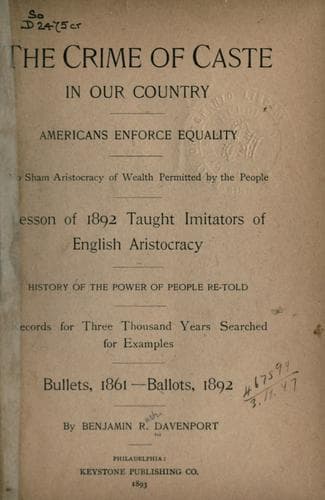
The Crime of Caste in Our CountryDavenport, Benjamin Rush
History
The Crime of Caste in Our Country
Davenport, Benjamin Rush
Social problems; United States -- Social conditions -- 1865-1918
It was night, yet the streets were not deserted. Suddenly a window
of the Ebbitt House was raised, a man stepped on to the balcony out
of the window, and in clear, vigorous, and manly tones began to sing
“The Star-Spangled Banner.” Windows were raised; the crowd collected
around the Ebbitt House. It was the signal for the breaking of a dam.
A flood of patriotism burst from the hearts of the hearers; it was the
bugle note, calling upon Americans to save their country. Where there
had been silence, were now outspoken vows of fidelity and loyalty
to the Union. The battle was won that night; not at Gettysburg and
Vicksburg[1].
Just so with the people of America in 1892; for years they have
endured in silence, murmuring and thinking, heart to heart speaking by
responsive heart throbs; not by word. The rich, who had accumulated
their wealth by reason of monopolies which were the necessary
consequence of the Civil War, men who had laid the foundation of
their fortunes by speculating upon the necessities of the government
while contending for the very existence of the Union, had, year by
year, by a stealthy, yet ever-increasing presumption, begun to assume
the possibility of a class distinction, presuming that the possession
of wealth entitled them to privileges, and arrogating to themselves
mannerisms of the titled classes of Europe, adopting crests, coats of
arms, claiming descent from titled foreigners, an exclusiveness in
their social relations, disregarding the laws of morality. The women of
this would-be aristocratic class, flaunting their jewels and laces in
the faces of their poorer sisters, with elevated noses, and garments
drawn aside, feared to touch or gaze at the poor but honest mothers and
wives of America.
It was not much: it was rank presumption; it was nonsense, absurd.
“There’s no such thing possible in America as class distinction; in
fact, it does not exist, cannot exist; the ‘Four Hundred’ of New York
is a joke, a by-word, a stupendous folly.”
But, good people of the said “Four Hundred,” remember that while the
American is neither a Socialist nor an Anarchist, when you presume to
make a distinction, socially, between the poor man, his wife, children,
and mother, you touch him in the most sensitive part of his being. You
may have your villas at Newport, you may ape the English fashionable
season in London by a similar one in New York; you may have your steam
yachts; you may ride to hounds; your women may marry divorced dukes and
puppified sons of lords; but, mark you, claim no privilege, attempt no
distinction between yourselves and the poorest honest man and woman in
the land. Equality is the jewel that every true American holds most
dear. No free son of our Republic will sell this treasure for gold,
whether it be offered directly as a bribe or shrewdly tendered under
the guise of “protected” wages.
Public-domain text, read in full here on John Shaqi.
Reviews
Reviews
No reviews yet
Be the first to share your thoughts on this work.
Join the Discussion
Join the discussion
Sign in to leave a comment or review.
Sign InorCreate an account