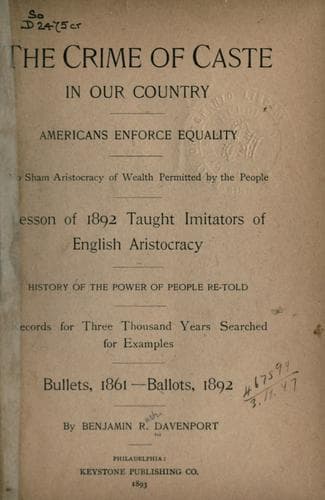
The Crime of Caste in Our CountryDavenport, Benjamin Rush
History
The Crime of Caste in Our Country
Davenport, Benjamin Rush
Social problems; United States -- Social conditions -- 1865-1918
The women of the land made more speeches, and effective speeches,
to the voters of the land when they thought of the much-advertised
American Duchess. They had felt most keenly--for woman’s life is social
much more than man’s--the attempted social distinction; and, strange as
it may appear to some of the skillful politicians that they had never
recognized it, the women of America had become largely Democratic, and
in them the Democratic party had its most powerful orators; for even
the most brutal, neglectful, and unloving husband resents in a vigorous
manner the least slight or insult offered to his wife. Upon every
occasion, gathering, entertainment, charitable undertaking, some wife
had been slighted. Because of the attempted creation of “caste,” she
became a powerful factor, at once, in the campaign of the people. It
mattered not whether her husband was a millionaire or not, no matter in
what portion of society,--the clerk in a dry-goods store, the farmer,
the banker, the millionaire,--the same result would follow. Some would
attempt to arrogate to themselves a better position, and claim certain
superiority over her. The banker’s wife feels as keenly the slight of
the wife of a railroad president, as the wife of a longshoreman does
any assumed difference in social position on the part of the wife of
the retail grocer.
This all-prevailing crime of “caste” does not, like most crimes are
supposed to do, originate in the gutter, but it permeates the mass of
the population, like the source of a great river, starting at the very
top of the mountain, and dripping constantly downward.
The example of the rich in imitating the immoralities of the privileged
classes of Europe, presents a spectacle of presumed immunity from the
consequences of their crimes which would be as detrimental to the
continuation of the purity of American homes, as the increase of the
feeling of “caste” would be to the happiness of the people. A most
beautiful illustration of corruption in high places was presented
in the disgusting and nauseating Drayton-Borrowe affair, wherein the
daughter of an Astor, a multi-millionaire, one of the members of the
supposed upper “caste,” is paraded before the public as imitating the
vices and immoralities of the Court of Charles II. Yet these same
Astors would claim, by reason of their assumed position, some exemption
from the result of the crime, which would not be accorded to the wife
of a farmer, clerk, or a bank cashier, to say nothing of the fact
that, had this beautiful sample of America’s sham aristocracy been
a laborer’s wife, she would, by the peculiar ethics adopted by the
corrupt English aristocracy, have been a fit subject for the police
court.
Public-domain text, read in full here on John Shaqi.
Reviews
Reviews
No reviews yet
Be the first to share your thoughts on this work.
Join the Discussion
Join the discussion
Sign in to leave a comment or review.
Sign InorCreate an account