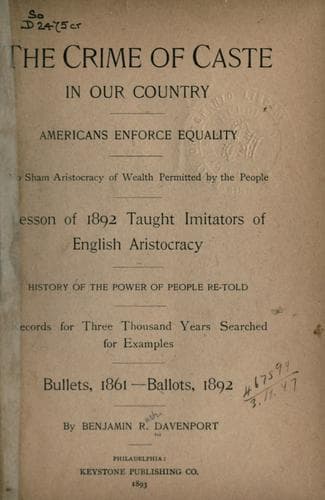
The Crime of Caste in Our CountryDavenport, Benjamin Rush
History
The Crime of Caste in Our Country
Davenport, Benjamin Rush
Social problems; United States -- Social conditions -- 1865-1918
The question was settled, by these very veterans, from 1861 to ’65 with
bullets, and it was utterly unavailing to call upon them for ballots in
1892 against the cause for which they fought in 1861.
The very negro said to himself: “You gave us freedom, the Republican
party, but the Republican party of Abraham Lincoln was purely a
Democratic party, in a broader sense.” To the negro’s mind, no three
Presidents of the past will more thoroughly represent a picture
pleasing to the eye of the enslaved or the lower classes, than
Jefferson, Jackson, and Lincoln. All were Democrats--men who believed
in the people and labored for the people, leading lives of pure
simplicity, affecting no superiority of rank or position. It was
useless to attempt to hold the negro vote.
The very name of the “People’s Party,” so strongly did it indicate and
describe this sentiment of the people; enabled that party, with all its
incongruous doctrines, to carry the electoral votes of some States of
the Union.
How frivolous seemed the claim of the Democratic papers and
politicians, that the popularity of Grover Cleveland, and the
confidence that people had in his rectitude and honesty, caused this
revolution. How it appears to be trifling with truth to ascribe the
victory of the people, the true Democracy, to the “masterly manner in
which Mr. Harrity managed the campaign.” Mr. Whitney’s diplomacy, Mr.
Dickinson’s energy and ability, Mr. Sheehan’s shrewdness, sink into
utter insignificance, and become as a grain of sand upon the seashore,
where they have happened to be tossed by the mighty wave of the ocean
of feeling, full of resentment, that filled the hearts of the people.
Their little all was but the piping of a penny whistle in a gale of
wind. W. H. Vanderbilt’s four words, “The public be damned,” uttered
from the pedestal of $150,000,000, made a greater impression, and
became more indelibly impressed upon the minds of the whole people,
ranging in wealth from $10,000,000 to less than a cent, than all the
management of Harrity, the diplomacy of Whitney, the skill of Sheehan,
or the energy of Dickinson. The reported expression of Mr. Russell
Harrison, when asked, while in London, what his position was in
America, as son of the President,--“Oh, about what the Prince of Wales
is here,”--was thought of and resented to greater purpose than was
produced by all the speeches of the eloquent Cockran.
Public-domain text, read in full here on John Shaqi.
Reviews
Reviews
No reviews yet
Be the first to share your thoughts on this work.
Join the Discussion
Join the discussion
Sign in to leave a comment or review.
Sign InorCreate an account