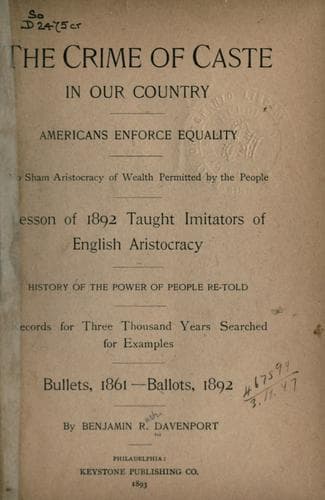
The Crime of Caste in Our CountryDavenport, Benjamin Rush
History
The Crime of Caste in Our Country
Davenport, Benjamin Rush
Social problems; United States -- Social conditions -- 1865-1918
“On June 30th, the company locked out all men before they had the
opportunity to strike. The wages question was soon lost sight of,
and the contest for the recognition of organized labor followed.
On the dawn of July 6th, the famous battle took place between the
workmen on the mill property and the Pinkerton force attempting to
land and take possession of the mill.
“Then followed the trying times at Homestead, the reign of the
Advisory Board, the scenes of lawlessness, the calling out of
the troops, their long and trying stay, the shooting of Mr.
Frick by Berkman, the departure of the troops, the arrest of the
Homesteaders, the beginning of their trials, and now the ending of
the strike.
“According to Superintendent Wood, of the Homestead works, not
more than 800 or 900 of the total number of old employés will be
able to secure employment. Before the break of last Thursday,
there were left in Homestead about 2,800 of the original 3,800 men
who were locked out. Of these 2,800 men, 2,200 were mechanics and
laborers and 600 Amalgamated Association men.”
If Carnegie, Frick, son-in-law W. Seward Webb, of the New York Central
Road, and men of that class can find any comfort in this evidence that
the “Common People” have at last realized the utter lack of merit
in their weapons, called “Organizations and Associations of Labor,”
then most heartily are they to be congratulated. Let them enjoy for a
brief period their dreams of autocratic power; for there will be a sad
awakening as the result of the realization upon the part of the people
that the ballot-box is the place for effective battle, and not the
lodge rooms of Associations and Organizations.
Grover Cleveland is the Grand Master of the great Organization of the
Associated People, who legally will now enforce the demands of the
“Common People.”
The defeated laborer, mechanic, and workman of Homestead has a prospect
before him, so full of hope and promise, presenting a picture so
pleasing to his oppressed soul, that the scene of his disastrous defeat
becomes obliterated. Let him turn from those days of suffering, so
vividly portrayed by the _Herald_ of November 25th:--
“There were dozens of tables in Homestead to-day where the
Thanksgiving Day bird was absent, and on many of these tables
hunger was the only sauce in sight.
“To-day while plenty ruled in American homes, starvation and cold
were closing their grip on the families of the Homestead strikers.
While the horn of plenty unrolled its golden store into the hands
of the nation, there were children in Homestead crying for bread,
with weeping mothers and despairing fathers.
Public-domain text, read in full here on John Shaqi.
Reviews
Reviews
No reviews yet
Be the first to share your thoughts on this work.
Elsewhere in the archive
Join the Discussion
Join the discussion
Sign in to leave a comment or review.
Sign InorCreate an account