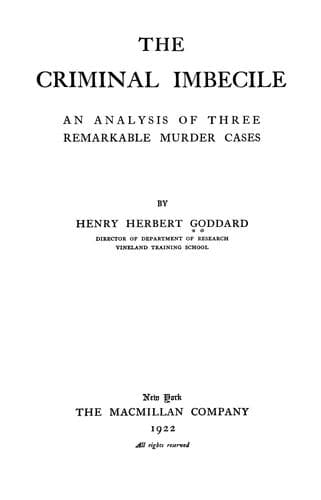
The Criminal Imbecile: An Analysis of Three Remarkable Murder CasesGoddard, Henry Herbert
Science
The Criminal Imbecile: An Analysis of Three Remarkable Murder Cases
Goddard, Henry Herbert
Crime -- Case studies; Murder -- Case studies; Offenders with mental disabilities -- Case studies
These facts and circumstances alone are enough to satisfy any person who
is familiar with the character of the inmates of our institutions for the
feeble-minded that Jean was an imbecile and really belonged in an
institution. But besides these circumstances several witnesses were
introduced who testified to the curious and childish actions of Jean in
his past history. Quite recently, he had tried to catch pigeons by putting
salt on their tails. The prosecuting attorney called attention to the fact
that almost every man remembers going through the same experience, but it
may be safely asserted that this is not done by any normal boy after the
age of twelve. It is a childish act, and indicates a mentality of less
than eleven.
Peter Black, the village blacksmith, testified that some one sent Jean to
him one day for "strap oil"; that he carried out the joke by slapping
Jean with a strap, but was unable to make him see that the whole thing was
a joke. He teased and bullied the other children in a way that is
characteristic of the high-grade imbecile. Mrs. Anna Newman testified that
he was a restless boy, and that sometimes he would answer her questions
and sometimes not. Every superintendent of an institution for the
feeble-minded would instantly recognize these characteristics as common
among his inmates. The reader will find more of these incidents in the
Appendix, pp. 113-119.
One of the unique features, so far as court procedure is concerned, was
the introduction into the case, of examinations by means of the
Binet-Simon Measuring Scale of Intelligence. The writer's examination of
Jean consisted largely of the use of these tests, and as a result he
estimated his mentality at approximately ten years of age. It was somewhat
difficult to estimate his mentality with the usual exactness since others
had already used the tests, and it was impossible to say how much Jean had
learned from his previous examinations. As a matter of fact, in some cases
at least, he had not profited by the experiences which should have helped
him greatly had he been a normal boy. For example, one of the tests is to
draw from memory a diagram which he has been allowed to study for ten
seconds. It is clear that if one were given this test two or three times,
at the last trial he should have a pretty good idea of it and be able to
draw it correctly. Although the writer's use of this test was in the last
of the series of those who tested him, yet he did not succeed in drawing
it. This is usually drawn by a child of ten years. When asked to repeat a
certain sentence, he replied, "Oh, I have been asked that a hundred
times." But in spite of the fact that he had heard it several times he
failed to remember it, and yet this sentence is generally remembered by a
child of twelve.
Public-domain text, read in full here on John Shaqi.
Reviews
Reviews
No reviews yet
Be the first to share your thoughts on this work.
Join the Discussion
Join the discussion
Sign in to leave a comment or review.
Sign InorCreate an account