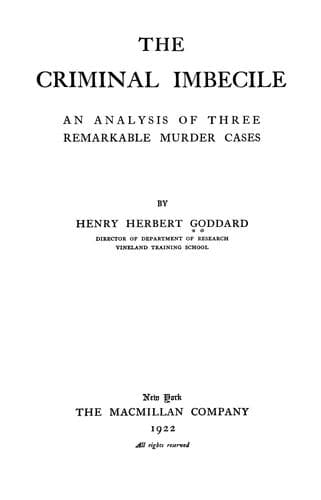
The Criminal Imbecile: An Analysis of Three Remarkable Murder Cases — John Shaqi
The Criminal Imbecile: An Analysis of Three Remarkable Murder CasesGoddard, Henry Herbert
Science
The Criminal Imbecile: An Analysis of Three Remarkable Murder Cases
Goddard, Henry Herbert
Crime -- Case studies; Murder -- Case studies; Offenders with mental disabilities -- Case studies
This is not the place nor is it necessary to discuss the Binet tests
themselves. A word, however, may be said as to why the experts for the
prosecution did not get the same results with the tests that those of the
defense obtained. Also it seems necessary to make a brief explanation,
since the prosecuting attorney failed so markedly to understand the tests
in spite of the fact that he had had the instruction of one of his own
experts who used them. One of the prosecution's experts told the writer
that he did not ask Jean any questions except those in the twelve-year
list, and he "seemed to do those satisfactorily." There are two sources of
error in this. In the first place, Jean's failures were not only in the
twelve-year, but in the eleven and ten. Secondly, if Jean seemed to do the
twelve-year tests correctly, it could only have been because they were
wrongly used. The Binet Scale is not, as the prosecutor insisted on
stating, an "arbitrary system." It is not a set of questions to which
there are definite and fixed answers that are correct, and from which any
deviation is marked a failure. Nor is it a set of questions the answers to
which can be judged as to their correctness by the so-called "common
sense" of the investigator. To illustrate: Jean was asked to give the
definition of the word "charity"; he said, "Charity is giving." The
prosecuting attorney insisted that this was a correct answer, because, as
he said, "Charity _is_ giving." This is mere sophistry. It is not a
question as to whether "charity is giving" is a theoretically correct
answer to the question; the important point is, that such an answer is
_not the kind of answer that is given by twelve-year-old children_. This
has been proved by asking hundreds of twelve-year-old children to define
"charity." Practically 75 per cent of such children include not only the
idea of giving, but the other necessary idea of giving to some one who is
in need. The answer, "Charity is giving," is characteristic not of
twelve-year mentality, but of something under that,--ten or less. So
throughout the system the scale must not be judged by what seem correct or
incorrect answers to the inexperienced adult. The value of an answer can
only be known by knowing the character of answers that are given by
children of the various ages. The point is not always that this answer is
or is not technically correct, but that it is not the kind of answer which
a child of the specified age should give. Therefore, it indicates that he
is not of that age, but below it. This was the error into which the
prosecutor and his alienists had fallen in their use of the tests in the
case of Jean Gianini.
Public-domain text, read in full here on John Shaqi.
Reviews
Reviews
No reviews yet
Be the first to share your thoughts on this work.
Join the Discussion
Join the discussion
Sign in to leave a comment or review.
Sign InorCreate an account