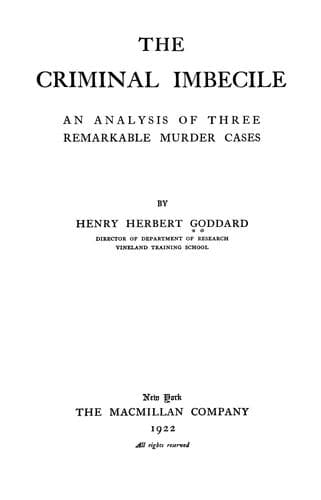
The Criminal Imbecile: An Analysis of Three Remarkable Murder Cases — John Shaqi
The Criminal Imbecile: An Analysis of Three Remarkable Murder CasesGoddard, Henry Herbert
Science
The Criminal Imbecile: An Analysis of Three Remarkable Murder Cases
Goddard, Henry Herbert
Crime -- Case studies; Murder -- Case studies; Offenders with mental disabilities -- Case studies
One of the witnesses for the prosecution said that he considered that Jean
was normal and that his apparent backwardness was due to lack of
schooling. This is a common error in all such cases. If asked why a boy
should be backward through lack of schooling when he has been to school
and has had every opportunity to learn, it is common again to fall back
upon the idea that he has not studied. He has been a wild, wayward boy,
playing truant, more or less, and has never applied himself, therefore he
is behind his grade and is dull and backward. Again, while not denying
that there are children of perfectly normal intelligence who seem to be
misfits in school or who seem more interested in other things than in
their school work, or children who will not study because of dislike for
the teacher or for various other reasons, yet the reader must be reminded
that a study of the high-grade defective shows that he is continually
being confused with these very exceptional children who have the ability
but who do not study. In other words, when a boy does not get along in
school, even though it is evident that he does not study, the strong
probability is that he does not study because he has not mind enough to
appreciate the work, to understand it, hence to have that highest of all
incentives to work, success. The fact that the majority of boys do get
their lessons and get along well in school should be a strong argument
that there is something seriously wrong with those that do not succeed.
It may further be asked: How does the fact that the boy has not succeeded
in school affect his examination by the Binet test? Experience has shown
that the test is affected but slightly. In other words, the mind develops
regardless of school and school training. As long as we ask only such
questions as call for a general intelligence and do not call for specific
school instruction we are reasonably independent of such instruction. As a
matter of fact, nearly all of the questions of the Binet Scale are free
from this objection. Some of them, it is true, are a little helped if the
child has been to school and correspondingly hard if the child has not
been to school; but, on the whole, they do not affect the final rating to
any serious extent. This has been proven repeatedly by normal children
who, on account of sickness or for other reasons, have not been to school,
and yet can pass the Binet tests for their own age.
Public-domain text, read in full here on John Shaqi.
Reviews
Reviews
No reviews yet
Be the first to share your thoughts on this work.
Join the Discussion
Join the discussion
Sign in to leave a comment or review.
Sign InorCreate an account