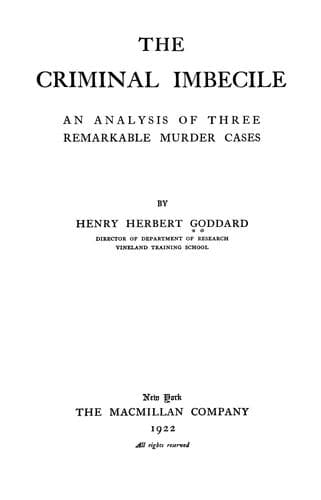
The Criminal Imbecile: An Analysis of Three Remarkable Murder Cases — John Shaqi
The Criminal Imbecile: An Analysis of Three Remarkable Murder CasesGoddard, Henry Herbert
Science
The Criminal Imbecile: An Analysis of Three Remarkable Murder Cases
Goddard, Henry Herbert
Crime -- Case studies; Murder -- Case studies; Offenders with mental disabilities -- Case studies
While in jail he showed no realization of the seriousness of his
situation; showed no remorse for his deed; took no interest in his case.
For example, he was told by his lawyer not to allow himself to be examined
by any doctors without sending for his counsel; in spite of this warning
he allowed himself to be examined by four physicians at one time and by
two at another, and never mentioned the matter to his counsel even after
it was done.
In the confession made to the prosecuting attorney one notices, as in the
one we have quoted, that he appears simple and innocent; answers the
questions often in terms of the questioner instead of by a simple "Yes" or
"No," which would be natural for a normal young man; he is uncertain and
hesitates; he says, "I think," in a great many cases where it was strongly
to his advantage to speak positively.
After the deed was committed he _took no care to remove the evidence_;
everything that was done in that connection was done at the _suggestion of
George March_. All the way through this part of the confession it
reads--"He led, I followed," "I did as he told me."
Having satisfied ourselves that Roland Pennington is a high-grade
imbecile, the next question is, even as an imbecile, why did he do this
deed.
In the case of Jean Gianini we found that it was for revenge of a fancied
wrong, that is, according to his own statement. If not that, it may have
been a sexual matter. In this case neither motive applies, and we have
only two possible theories. The theory of the state was that it was for
robbery. Indeed, Roland himself seems to admit that this was the motive.
But this again is only a part of his imbecility. He was given a leading
question by the prosecution and was weak-minded enough to say, "Yes."
As a matter of fact one finds it very hard to get any evidence from the
whole situation that he really was lead by cupidity. There is no evidence
of any elaborate plans in regard to money, either as to getting it or as
to what was to be done with it when he got it. March had talked about a
thousand-dollar bill, and asked Pennington how he would like to have "that
bunch of money." Pennington says he does not remember saying anything in
reply. This does not look as though it aroused any great emotion in him.
Later March said--referring to the money Pinkerton was supposed to have
"on him"--"Let's get it." Pennington asks, "What do you mean?" He is
clearly thinking less of the money than of what he begins to dimly
understand they are to do. When he understands that they are to kill him,
he says distinctly, "No. I won't kill him." Never again is the subject of
money mentioned. In all March's urging him to do the deed he never says,
"Remember the money," or alludes to money in any way.
Public-domain text, read in full here on John Shaqi.
Reviews
Reviews
No reviews yet
Be the first to share your thoughts on this work.
Join the Discussion
Join the discussion
Sign in to leave a comment or review.
Sign InorCreate an account