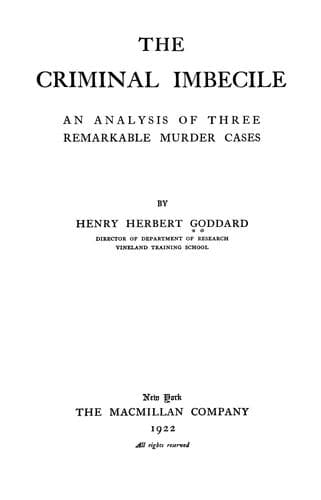
The Criminal Imbecile: An Analysis of Three Remarkable Murder CasesGoddard, Henry Herbert
Science
The Criminal Imbecile: An Analysis of Three Remarkable Murder Cases
Goddard, Henry Herbert
Crime -- Case studies; Murder -- Case studies; Offenders with mental disabilities -- Case studies
It is an interesting little point, possibly only a coincidence but
nevertheless a perfectly natural imbecilic association, that the one
seemingly original thing that the boy did in connection with the matter
was to invent a little trick in regard to the nail in the stall. It is
quite likely that even this was suggested by George's previous expression,
"Nail him."
Even the blow itself does not seem to have been given with normal vigor;
having every advantage,--the victim bending over, Roland being behind him
and with a blackjack which is capable of thoroughly stunning, if not
killing at one blow,--he apparently did not strike with force enough to
even produce unconsciousness. His victim was able to talk and to struggle
for some minutes, until March, the companion in crime, came up and, as he
expressed it, "finished him."
As to motive, then, we conclude that the defendant had none. He was acting
upon the suggestion of George March. Even the poor mind that he had, which
under other circumstances might possibly have rebelled at such a
suggestion, was lulled to sleep by this man of better intelligence for
whom he had been working and who he had learned to think was "good and
kind" and on whose judgment he thought he could rely.
Since the Pennington case is typical of the way weak minds work under
control of normal minds, it will be worth while to analyze somewhat more
fully this idea of _suggestion_.
How does suggestion work? Why does it indicate a weak mind and how does it
affect our ideas of responsibility? Let us see.
We have already seen that Roland Pennington was under the control of
another mind; we do not mean that he was actually hypnotized--a
nonsensical plea that is sometimes brought into court cases. Roland
Pennington was a victim of suggestion. An illustration will make this
clear.
If I were to take a city man to a third-rail electric road and ask him to
stand on one rail and put his hand on the third rail, he would resist the
suggestion, because there would immediately come into his mind visions of
himself burned to a crisp or instantly killed. But suppose I take a man
who has come from the rural districts and who never heard of third rails.
He has lived, let us assume, in my house and worked under my direction a
month and has come to regard me as a friend. We have worked together and
talked together; I take him out and say, "Touch that third rail." Will he
resist the suggestion? Not at all. Why not? What is the difference between
the two men? The first has ideas about third rails. His past experience
has filled his mind and memory with thoughts and with knowledge which
instantly come to consciousness when I suggest touching the third rail.
The other man has no such experience. He has known me long enough to have
some faith in me. In fact from the very nature of things he is in the
habit of doing what I tell him. I tell him to do this, and he does it.
Public-domain text, read in full here on John Shaqi.
Reviews
Reviews
No reviews yet
Be the first to share your thoughts on this work.
Join the Discussion
Join the discussion
Sign in to leave a comment or review.
Sign InorCreate an account