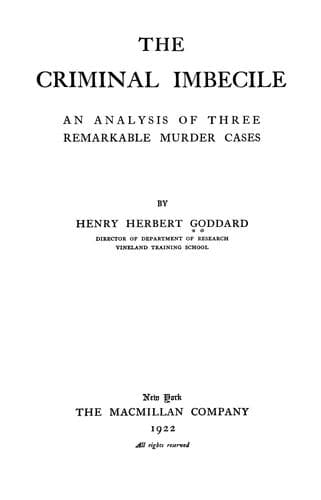
The Criminal Imbecile: An Analysis of Three Remarkable Murder Cases — John Shaqi
The Criminal Imbecile: An Analysis of Three Remarkable Murder CasesGoddard, Henry Herbert
Science
The Criminal Imbecile: An Analysis of Three Remarkable Murder Cases
Goddard, Henry Herbert
Crime -- Case studies; Murder -- Case studies; Offenders with mental disabilities -- Case studies
Coming back to the first case, one perhaps can conceive that the city man
and I might come upon the third rail under such conditions that he was not
thinking of it. Instead of saying "third rail" to him I might say, "My!
that rail is hot" and he would almost instinctively put his hand upon it
to verify my remark. If he survived and could talk about it afterwards, he
would say, "Of course I ought to have known and did know that was the
third rail, but I did not think." That is the way suggestion works.
To illustrate still further, we may speak of hypnotism itself. All of the
wonders that are produced under hypnosis are to be explained in exactly
this way. The subject is so nearly asleep that nothing gets into his
consciousness except the ideas suggested by the operator. Accordingly he
is utterly unable to resist any suggestion that is given him.
Now coming nearer to our problem, children are naturally very suggestible
because they have not the experiences, the ideas. One may easily believe
that an eleven-year-old child could be induced to touch the third rail.
Furthermore, authority plays an enormous rôle with children. I might take
my ten-year-old boy out for a walk. He knows all about third rails and
would not touch one. But if I were to say to him, "Son, you can put your
hand on this, because there is no current on," he would probably obey
without question, because of his implicit trust in me. That confidence in
a superior, either in age, intelligence, or position, is one of the
characteristics of immature minds and one of the conditions that makes us
all suggestible. In the hypnotic terminology again, this is the being _en
rapport_. The hypnotized subject obeys the operator and no one else
because it is the operator with whom he is _en rapport_--in other words,
in whom he has confidence.
Now let us come to the situation. It is perfectly clear that Roland
Pennington was under strong suggestion and that any vague concepts that he
might have had of the wrongfulness of murder or of killing a man were very
carefully allayed by the man who had the influence over him and who had
the motive for this homicide.
The whole statement shows that Roland recognized George as a superior, as
one in authority over him and at the same time as a friend, as one on
whose word he could absolutely rely. It is a perfect picture of the child
following the man.
CHAPTER III
THE CASE OF FRED TRONSON
Public-domain text, read in full here on John Shaqi.
Reviews
Reviews
No reviews yet
Be the first to share your thoughts on this work.
Join the Discussion
Join the discussion
Sign in to leave a comment or review.
Sign InorCreate an account