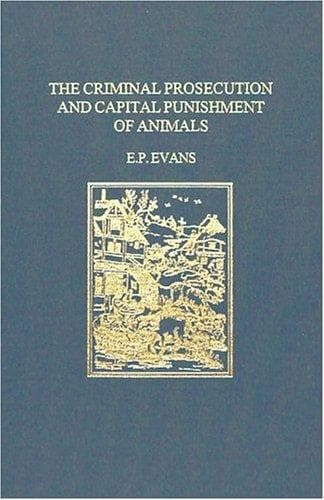
The Criminal Prosecution and Capital Punishment of AnimalsEvans, E. P. (Edward Payson)
History
The Criminal Prosecution and Capital Punishment of Animals
Evans, E. P. (Edward Payson)
Animals -- Law and legislation -- History; Animals, Prosecution and punishment of -- History; Trials -- Europe
The ancient Greeks held that a murder, whether committed by a man, a
beast, or an inanimate object, unless properly expiated, would arouse the
furies and bring pestilence upon the land; the mediæval Church taught the
same doctrine, and only substituted the demons of Christian theology for
the furies of classical mythology. As early as 864, the Council of Worms
decreed that bees, which had caused the death of a human being by stinging
him, should be forthwith suffocated in the hive before they could make any
more honey, otherwise the entire contents of the hive would become
demoniacally tainted and thus rendered unfit for use as food; it was
declared to be unclean, and this declaration of impurity implied a
liability to diabolical possession on the part of those who, like Achan,
“transgressed in the thing accursed.” It was the same horror of aiding
and abetting demons and enabling them to extend their power over mankind
that caused a cock, which was suspected of having laid the so-called
“basilisk-egg,” or a hen, addicted to the ominous habit of crowing, to be
summarily put to death, since it was only by such expiation that the evil
could be averted.
A Swiss jurist, Eduard Osenbrüggen (_Studien zur deutschen und
schweizerischen Rechtsgeschichte._ Schaffhausen, 1868, p. 139-149),
endeavours to explain these judicial proceedings on the theory of the
personification of animals. As only a human being can commit crime and
thus render himself liable to punishment, he concludes that it is only by
an act of personification that the brute can be placed in the same
category as man and become subject to the same penalties. In support of
this view he refers to the fact that in ancient and mediæval times
domestic animals were regarded as members of the household and entitled to
the same legal protection as human vassals. In the Frankish capitularies
all beasts of burden or so-called juments were included in the king’s ban
and enjoyed the peace guaranteed by royal authority: _Ut jumenta pacem
habent similiter per bannum regis_. The weregild extended to them as it
did to women and serfs under cover of the man as master of the house and
lord of the manor. The beste covert, to use the old legal phraseology, was
thus invested with human rights and inferentially endowed with human
responsibilities. According to old Welsh law atonement was made for
killing a cat or dog belonging to another person by suspending the animal
by the tail so that its nozzle touched the ground, and then pouring wheat
over it until its body was entirely covered. Old Germanic law also
recognized the competency of these animals as witnesses in certain cases,
as, for example, when burglary had been committed by night, in the absence
of human testimony, the householder was permitted to appear before the
court and make complaint, carrying on his arm a dog, cat or cock, and
holding in his hand three straws taken from the roof as symbols of the
house.
Public-domain text, read in full here on John Shaqi.
Reviews
Reviews
No reviews yet
Be the first to share your thoughts on this work.
Join the Discussion
Join the discussion
Sign in to leave a comment or review.
Sign InorCreate an account