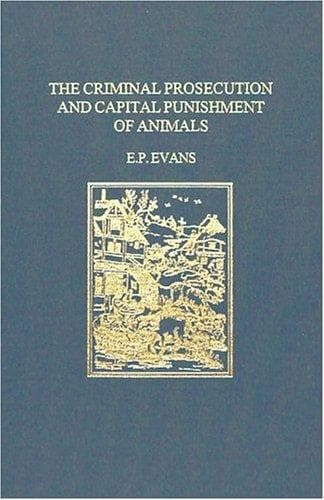
The Criminal Prosecution and Capital Punishment of AnimalsEvans, E. P. (Edward Payson)
History
The Criminal Prosecution and Capital Punishment of Animals
Evans, E. P. (Edward Payson)
Animals -- Law and legislation -- History; Animals, Prosecution and punishment of -- History; Trials -- Europe
“godliness is profitable” not only “unto all things,” but also, as
mediæval writers were wont to say, unto some things besides, which the
apostle Paul in his admonitions to his “son Timothy” never dreamed of. We
are also told that the _aura corrumpens_ resulting from diabolical
infestation imparts to the dwelling a peculiar taint, which it often
retains for a long time after the demons have been cast out, so that
sensitive persons cannot enter such a domicile without getting nervously
excited, slightly dizzy and all in a tremble. The carnal mind, which is at
enmity with all supernatural explanations of natural phenomena, would seek
the source of such sensations in an _aura corrumpens_ arising from the
lack of proper ventilation, and find relief by simply opening the windows
instead of calling in a priest with aspergills, and censers, and
_benedictiones locorum_.
We have a striking illustration of this truth in the frequent cases of
“bewitched kine.” European peasants often confine their cattle in stalls
so small and low that the beasts have not sufficient air to breathe. The
result is that a short time after the stalls are closed for the night the
cattle get excited and begin to fret and fume and stamp, and are found in
the morning weak and exhausted and covered with sweat. The peasant
attributes these phenomena to witchcraft, and calls in an exorcist, who
proceeds to expel the evil spirits. Before performing the ceremony of
conjuration, he opens the doors and windows and the admission of fresh
air makes it quite easy to cast out the demons. A German veterinarian, who
reports several instances of this kind, tried in vain to convince the
peasants that the trouble was due, not to sorcery, but to the absence of
proper sanatory conditions, and finally, in despair of accomplishing his
purpose in any other way, told them that if the windows were left open so
that the witches could go in and out freely, the demons would not enter
into the cattle. This advice was followed and the malign influence ceased.
Public-domain text, read in full here on John Shaqi.
Reviews
Reviews
No reviews yet
Be the first to share your thoughts on this work.
Join the Discussion
Join the discussion
Sign in to leave a comment or review.
Sign InorCreate an account