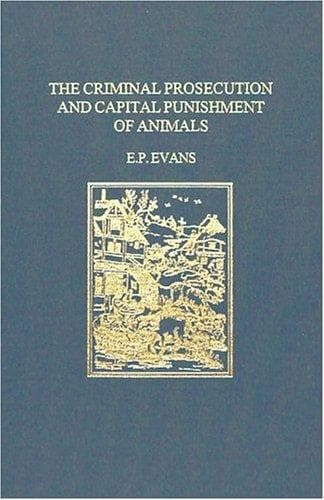
The Criminal Prosecution and Capital Punishment of AnimalsEvans, E. P. (Edward Payson)
History
The Criminal Prosecution and Capital Punishment of Animals
Evans, E. P. (Edward Payson)
Animals -- Law and legislation -- History; Animals, Prosecution and punishment of -- History; Trials -- Europe
This doctrine reduces confirmed criminals to the condition of ferocious
beasts and venomous reptiles, and logically demands that they should be
eliminated for precisely the same reason that noxious animals are
exterminated, although neither the human nor the animal creatures are to
blame for the perniciousness of their inborn proclivities and natural
instincts. In the eyes of Courcelle-Seneuil a prison is a “kind of
menagerie”; Naquet, the French chemist and senator, goes still farther,
declaring that men are no more culpable for being criminal than vitriol is
for being corrosive, and adding that it is our own fault if we put this
stuff into our tea and are poisoned by it. The same writer maintains that
“there is no more demerit in being perverse than in being cross-eyed or
hump-backed.” In a recent lecture on criminal jurisprudence and biology
Professor Benedikt cites the case of a Moravian robber and murderer, whose
brain was found on dissection to resemble that of a beast of prey and who
was therefore, in the opinion of the eminent Viennese authority, no more
responsible for his bloody deeds than is a lion or a tiger for its
ravages. The corollary to this anatomical demonstration is that one should
treat such a man as a lion or a tiger and shoot him on the spot. Atavistic
relapses, defective cerebral development and other abnormities
undoubtedly occur in criminals, whose acts may be traced, in some degree,
to these physical imperfections and therefore be pathologically stimulated
and partially necessitated by them. On the other hand, there are thousands
of persons with equally small and unsymmetrical craniums, who do not
commit crime, but remain respectable, safe, and useful members of society.
Public-domain text, read in full here on John Shaqi.
Reviews
Reviews
No reviews yet
Be the first to share your thoughts on this work.
Elsewhere in the archive
Join the Discussion
Join the discussion
Sign in to leave a comment or review.
Sign InorCreate an account