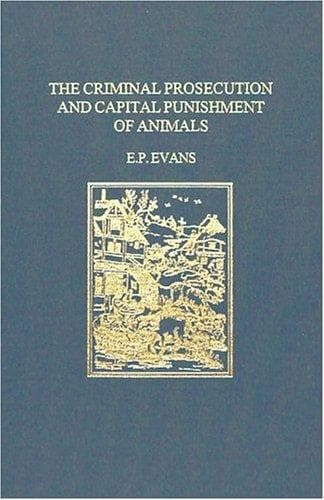
The Criminal Prosecution and Capital Punishment of AnimalsEvans, E. P. (Edward Payson)
History
The Criminal Prosecution and Capital Punishment of Animals
Evans, E. P. (Edward Payson)
Animals -- Law and legislation -- History; Animals, Prosecution and punishment of -- History; Trials -- Europe
practical tendencies, so far as they have been determined. It must be
remembered, however, that, although the savage spirit of revenge, that
eagerly demands blood for blood without the slightest consideration of the
anatomical, physiological or psychological conditions upon which the
commission of the specific act depends, has ceased to be the controlling
factor in the enactment and execution of penal codes, the new system of
jurisprudence, based upon more enlightened conceptions of human
responsibility, is still in an inchoate state and very far from having
worked out a satisfactory solution of the intricate problem of the origin
and nature of crime and its proper penalty.
In 1386, an infanticidal sow was executed in the old Norman city of
Falaise, and the scene was represented in fresco on the west wall of the
Church of the Holy Trinity in that city. This curious painting no longer
exists, and, so far as can be ascertained, has never been engraved. It has
been frequently and quite fully described by different writers, and the
frontispiece of the present volume is not a reproduction of the original
picture, but a reconstruction of it according to these descriptions. It is
taken from Arthur Mangin’s _L’Homme et la Bête_ (Paris, 1872), of which
all the illustrations are more or less fancy sketches. A full account of
the trial and execution is given in the present volume.
The iconographic edition of Jocodus Damhouder’s _Praxis Rerum Criminalium_
(Antverpiæ, 1562) contains at the beginning of each section an engraving
representing the perpetration of the crimes about to be discussed. That at
the head of the chapter entitled “De Damno Pecuario” is a lively picture
of the injuries done by animals and rendering them liable to criminal
process; it is reproduced facing page 161 of the present work.
The most important documents, from which our knowledge of these judicial
proceedings is derived, are given in the Appendix, together with a
complete list of prosecutions and excommunications during the past ten
centuries, so far as we have been able to discover any record of them.
The bibliography, although making no claim to be exhaustive, comprises the
principal works on the subject. Articles and essays, which are merely a
rehash of other publications, it has not been deemed necessary to mention.
Such, for example, are “Criminalprocesse gegen Thiere,” in _Miscellen aus
der neuesten ausländischen Literatur_ (Jena, 1830, LXV. pp. 152-55),
Jörgensen’s _Nogle Frugter af mit Otium_ (Kopenhagen, 1834, pp. 216-23);
Cretella’s “Gli Animali sotto Processo,” in _Fanfulla della Domenica_
(Florence, 1891, No. 65), all three based upon the archival researches of
Berriat-Saint-Prix and Ménabréa, and Soldan’s “La Personification des
Animaux in Helvetia,” in _Monatsschrift der Studentenverbindung Helvetia_
(VII. pp. 4-17), which is a mere restatement of Osenbrüggen’s theory.
Public-domain text, read in full here on John Shaqi.
Reviews
Reviews
No reviews yet
Be the first to share your thoughts on this work.
Join the Discussion
Join the discussion
Sign in to leave a comment or review.
Sign InorCreate an account