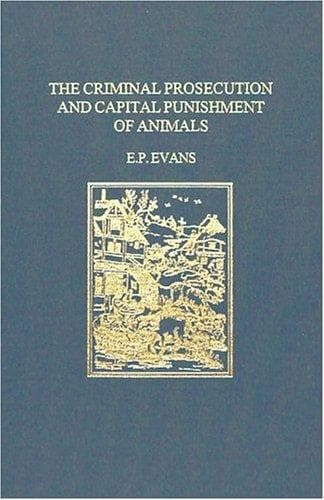
The Criminal Prosecution and Capital Punishment of AnimalsEvans, E. P. (Edward Payson)
History
The Criminal Prosecution and Capital Punishment of Animals
Evans, E. P. (Edward Payson)
Animals -- Law and legislation -- History; Animals, Prosecution and punishment of -- History; Trials -- Europe
In conclusion the author desires to express his sincere thanks to Dr.
Laubmann, Director of the Munich Hof- und Staatsbibliothek, as well as to
the other custodians of that library, for their uniform kindness and
courtesy in placing at his disposal the printed and manuscript treasures
committed to their keeping.
CHAPTER I
BUGS AND BEASTS BEFORE THE LAW
It is said that Bartholomew Chassenée,[1] a distinguished French jurist of
the sixteenth century (born at Issy-l’Evêque in 1480), made his reputation
at the bar as counsel for some rats, which had been put on trial before
the ecclesiastical court of Autun on the charge of having feloniously
eaten up and wantonly destroyed the barley-crop of that province. On
complaint formally presented by the magistracy, the official or bishop’s
vicar, who exercised jurisdiction in such cases, cited the culprits to
appear on a certain day and appointed Chassenée to defend them.
In view of the bad repute and notorious guilt of his clients, Chassenée
was forced to employ all sorts of legal shifts and chicane, dilatory pleas
and other technical objections, hoping thereby to find some loophole in
the meshes of the law through which the accused might escape, or at least
to defer and mitigate the sentence of the judge. He urged, in the first
place, that inasmuch as the defendants were dispersed over a large tract
of country and dwelt in numerous villages, a single summons was
insufficient to notify them all; he succeeded, therefore, in obtaining a
second citation, to be published from the pulpits of all the parishes
inhabited by the said rats. At the expiration of the considerable time
which elapsed before this order could be carried into effect and the
proclamation be duly made, he excused the default or non-appearance of his
clients on the ground of the length and difficulty of the journey and the
serious perils which attended it, owing to the unwearied vigilance of
their mortal enemies, the cats, who watched all their movements, and, with
fell intent, lay in wait for them at every corner and passage. On this
point Chassenée addressed the court at some length, in order to show that
if a person be cited to appear at a place, to which he cannot come with
safety, he may exercise the right of appeal and refuse to obey the writ,
even though such appeal be expressly precluded in the summons. The point
was argued as seriously as though it were a question of family feud
between Capulet and Montague in Verona or Colonna and Orsini in Rome.
Public-domain text, read in full here on John Shaqi.
Reviews
Reviews
No reviews yet
Be the first to share your thoughts on this work.
Join the Discussion
Join the discussion
Sign in to leave a comment or review.
Sign InorCreate an account