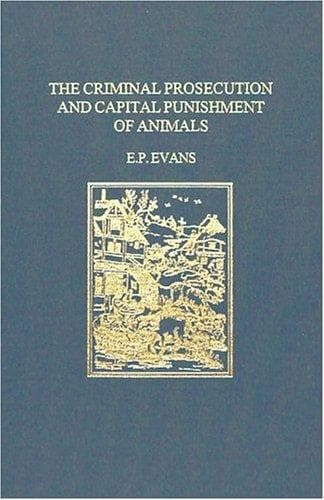
The Criminal Prosecution and Capital Punishment of AnimalsEvans, E. P. (Edward Payson)
History
The Criminal Prosecution and Capital Punishment of Animals
Evans, E. P. (Edward Payson)
Animals -- Law and legislation -- History; Animals, Prosecution and punishment of -- History; Trials -- Europe
In proof of the power of anathemas, Chassenée refers to the cursing of the
serpent in the Garden of Eden, causing it to go upon its belly for all
time; David’s malediction of the mountains of Gilboa, so that they had
neither rain nor dew; God’s curse upon the city of Jericho, making its
strong walls fall before the blasts of trumpets; and in the New Testament
the withered fig-tree of Bethany. The words of Jesus, “Every tree that
bringeth not forth good fruit is hewn down and cast into the fire,” he
interprets, not merely as the best means of getting rid of a cumberer of
the orchard, but as a condemnation and punishment of the tree for its
delinquencies, and adds: “If, therefore, it is permitted to destroy an
irrational thing, because it does not produce fruit, much more is it
permitted to curse it, since the greater penalty includes the less” (_cum
si liceat quid est plus, debet licere quid est minus_).
An English professor of divinity, Richard Chevenix Trench, justifies the
withering of the fruitless fig-tree on the same ground or, at least, by a
similar process of reasoning: “It was punished, not for being without
fruit, but for proclaiming by the voice of those leaves that it had such;
not for being barren, but for being false.” According to this exegesis, it
was the telling of a wilful lie that “drew on it the curse.” The guilty
fig is thus endowed with a moral character and made clearly conscious of
the crime for which it suffered the penalty of death: “Almost as soon as
the word of the Lord was spoken, a shuddering fear may have run through
all the leaves of the tree, which was thus stricken at the heart.” As
regards the culpability and punishableness of the object, the modern
divine and the mediæval jurist occupy the same standpoint; only the
latter, with a stricter judicial sense, insists that there shall be no
infliction of punishment until the malefactor has been convicted by due
process of law, and that he shall enjoy all the safeguards which legal
forms and technicalities have thrown around him and under whose covert
even the vilest criminal has the right to take refuge. The Anglican
hermeneutist, on the contrary, would justify the curse and admit the
validity of the anathema, although it was only the angry expression of an
unreasonable impatience disappointed in not finding fruit at the wrong
season, “for the time of figs was not yet.”
Public-domain text, read in full here on John Shaqi.
Reviews
Reviews
No reviews yet
Be the first to share your thoughts on this work.
Join the Discussion
Join the discussion
Sign in to leave a comment or review.
Sign InorCreate an account