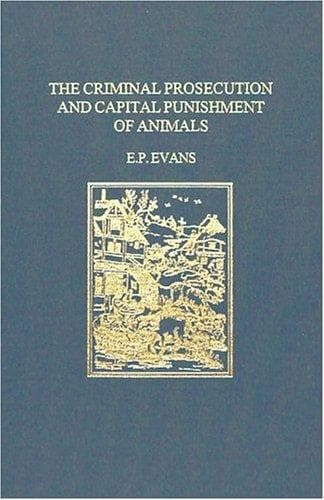
The Criminal Prosecution and Capital Punishment of AnimalsEvans, E. P. (Edward Payson)
History
The Criminal Prosecution and Capital Punishment of Animals
Evans, E. P. (Edward Payson)
Animals -- Law and legislation -- History; Animals, Prosecution and punishment of -- History; Trials -- Europe
to rational causes, but combines that of the lawyer, who quotes precedents
and examines witnesses, with that of the theologian, who balances
authorities and serves us with texts instead of arguments. He scrupulously
avoids all psychological speculation or metaphysical reasoning, and simply
aims to show that animals have been tried, convicted, and sentenced by
civil and ecclesiastical courts, and that the competence of these
tribunals has been generally recognized.
The documentary evidence adduced is drawn from a great variety of sources:
the scriptures of the Old and New Testament, pagan poets and philosophers,
patristic theologians and homilists, mediæval hagiologists, Virgil, Ovid,
Pliny, Cicero, Cato, Aristotle, Seneca, Silius Italicus, Boethius, Gregory
the Great, Pico della Mirandola, the laws of Moses, the prophecies of
Daniel, and the Institutes of Justinian are alike laid under contribution
and quoted as of equal authority. All is fish that comes to his net out
of his erudition, be it salmon or sea-urchin. If twelve witnesses can be
produced in favour of a statement, and only two against it, his reason
bows to the will of the majority, and accepts the proposition as proved.
It must be added, however, to his credit, that he proceeds in this matter
with strict impartiality and perfect rectitude, takes whatever evidence is
at hand, and never tries to pack the witness-box.
His knowledge of obscure and now utterly forgotten authors, secular and
ecclesiastic, is immense. Like so many scholars of his day he was
prodigiously learned, without being remarkable for clearness or
originality of thought. Indeed, the vastness of his erudition seems rather
to have hampered than helped the vigorous growth of his intellectual
faculties. He often indulges in logical subtilties so shallow in their
speciousness, that they ought not to deceive the veriest smatterer in
dialectics; and the reader is constantly tempted to answer his laboured
argumentations, as Tristram Shandy’s Uncle Toby did the lucubrations of
Corporal Trim, by “whistling half-a-dozen bars of Lillibullero.” The
examples he adduces afford striking illustrations of the gross credulity
to which the strongly conservative, precedent-mongering mind of the
jurisconsult is apt to fall an easy prey. The habit of seeking knowledge
and guidance exclusively in the records and traditions of the past, in the
so-called “wisdom of ages,” renders him peculiarly liable to regard every
act and utterance of antiquity as necessarily wise and authoritative.
Public-domain text, read in full here on John Shaqi.
Reviews
Reviews
No reviews yet
Be the first to share your thoughts on this work.
Join the Discussion
Join the discussion
Sign in to leave a comment or review.
Sign InorCreate an account