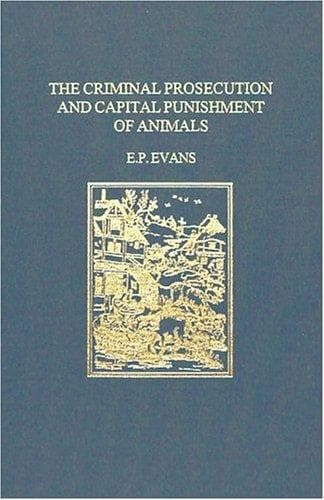
The Criminal Prosecution and Capital Punishment of Animals — John Shaqi
The Criminal Prosecution and Capital Punishment of AnimalsEvans, E. P. (Edward Payson)
History
The Criminal Prosecution and Capital Punishment of Animals
Evans, E. P. (Edward Payson)
Animals -- Law and legislation -- History; Animals, Prosecution and punishment of -- History; Trials -- Europe
Complaint was first made by the wine-growers of St. Julien in 1545 before
François Bonnivard, doctor of laws. The procurator Pierre Falcon and the
advocate Claude Morel defended the insects, and Pierre Ducol appeared for
the plaintiffs. After the presentation and discussion of the case by both
parties, the official, instead of passing sentence, issued a proclamation,
dated the 8th of May, 1546, recommending public prayers and beginning with
the following characteristic preamble: “Inasmuch as God, the supreme
author of all that exists, hath ordained that the earth should bring forth
fruits and herbs (_animas vegetativas_), not solely for the sustenance of
rational human beings, but likewise for the preservation and support of
insects, which fly about on the surface of the soil, therefore it would be
unbecoming to proceed with rashness and precipitance against the animals
now actually accused and indicted; on the contrary, it would be more
fitting for us to have recourse to the mercy of heaven and to implore
pardon for our sins.” Then follow instructions as to the manner in which
the public prayers are to be conducted in order to propitiate the divine
wrath. The people are admonished to turn to the Lord with pure and
undivided hearts (_ex toto et puro corde_), to repent of their sins with
unfeigned contrition, and to resolve to live henceforth justly and
charitably, and above all to pay tithes. High mass is to be celebrated on
three consecutive days, namely on May 20th, 21st, and 22nd, and the host
to be borne in solemn procession with songs and supplications round the
vineyards. The first mass is to be said in honour of the Holy Spirit, the
second in honour of the Blessed Virgin, and the third in honour of the
tutelar saint of the parish. At least two persons of each household are
required to take part in these religious exercises. A _procès-verbal_,
signed by the curate Romanet, attests that this programme was fully
carried out and that the insects soon afterwards disappeared.
About thirty years later, however, the scourge was renewed and the
destructive insects were actually brought to trial. The proceedings are
recorded on twenty-nine folia and entitled: _De actis scindicorum
communitatis Sancti Julliani agentium contra animalia bruta ad formam
muscarum volantia coloris viridis communi voce appellata verpillions seu
amblevins_. The documents, which are still preserved in the archives of
St. Julien, were communicated by M. Victor Dalbane, secretary of the
commune, to M. Léon Ménebréa, who printed them in the appendix to his
volume: _De l’origine de la forme et de l’esprit des jugements rendus au
moyen-âge contre les animaux_. Chambery, 1846. This treatise appeared
originally in the twelfth tome of the _Mémoires de la Société Royale
Académique de Savoie_.
Public-domain text, read in full here on John Shaqi.
Reviews
Reviews
No reviews yet
Be the first to share your thoughts on this work.
Join the Discussion
Join the discussion
Sign in to leave a comment or review.
Sign InorCreate an account