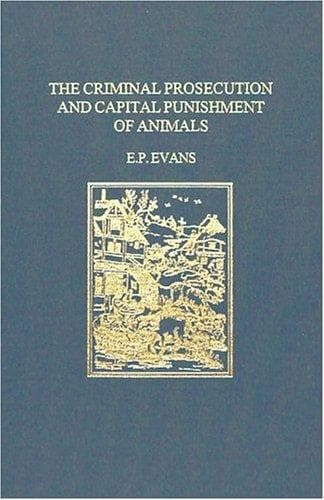
The Criminal Prosecution and Capital Punishment of Animals — John Shaqi
The Criminal Prosecution and Capital Punishment of AnimalsEvans, E. P. (Edward Payson)
History
The Criminal Prosecution and Capital Punishment of Animals
Evans, E. P. (Edward Payson)
Animals -- Law and legislation -- History; Animals, Prosecution and punishment of -- History; Trials -- Europe
It may be proper to add that Ménebréa’s theory of “the spirit, in which
these judgments against animals were given,” is wholly untenable. He
maintains that “these procedures formed originally only a kind of symbol
intended to revive the sentiment of justice among the masses of the
people, who knew of no right except might and of no law except that of
intimidation and violence. In the Middle Ages, when disorder reigned
supreme, when the weak remained without support and without redress
against the strong, and property was exposed to all sorts of attacks and
all forms of ravage and rapine, there was something indescribably
beautiful in the thought of assimilating the insect of the field to the
masterpiece of creation and putting them on an equality before the law. If
man should be taught to respect the home of the worm, how much more ought
he to regard that of his fellow-man and learn to rule in equity.”
This explanation is very fine in sentiment, but expresses a modern, and
not a mediæval way of thinking. The penal prosecution of animals, which
prevailed during the Middle Ages, was by no means peculiar to that period,
but has been frequently practised by primitive peoples and savage tribes;
neither was it designed to inculcate any such moral lesson as is here
suggested, nor did it produce any such desirable result. So far from
originating in a delicate and sensitive sense of justice, it was, as will
be more fully shown hereafter, the outcome of an extremely crude, obtuse,
and barbaric sense of justice. It was the product of a social state, in
which dense ignorance was governed by brute force, and is not to be
considered as a reaction and protest against club-law, which it really
tended to foster by making a travesty of the administration of justice and
thus turning it into ridicule. It was also in the interest of
ecclesiastical dignities to keep up this parody and perversion of a sacred
and fundamental institute of civil society, since it strengthened their
influence and extended their authority by subjecting even the caterpillar
and the canker-worm to their dominion and control.
Public-domain text, read in full here on John Shaqi.
Reviews
Reviews
No reviews yet
Be the first to share your thoughts on this work.
Join the Discussion
Join the discussion
Sign in to leave a comment or review.
Sign InorCreate an account