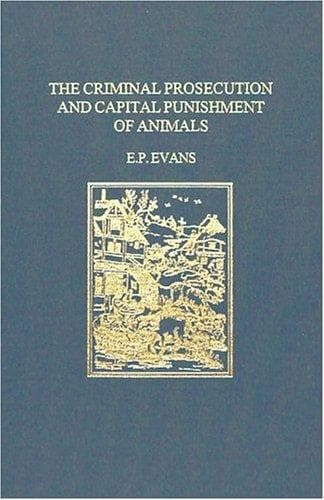
The Criminal Prosecution and Capital Punishment of AnimalsEvans, E. P. (Edward Payson)
History
The Criminal Prosecution and Capital Punishment of Animals
Evans, E. P. (Edward Payson)
Animals -- Law and legislation -- History; Animals, Prosecution and punishment of -- History; Trials -- Europe
On the 18th of July, the same parties appear before the official of St.
Jean-de-Maurienne. The procurator of the insects demands that the case be
closed and the plaintiffs debarred from drawing up any additional
statements or creating any further delay by the introduction of irrelevant
matter, and requests that a decision be rendered on the documents and
declarations already adduced. The prosecuting attorney, whose policy seems
to have been to keep the suit pending as long as possible, applies for a
new term (_alium terminum_), which was granted.
Meanwhile, in view of the law’s long delay, other measures were taken for
the speedier adjustment of the affair by compromise. On the 29th of June,
1587, a public meeting was called at noon immediately after mass on the
great square of St. Julien, known as Parloir d’Amont, to which all hinds
and habitants (_manants et habitants_) were summoned by the ringing of the
church bell to consider the propriety and necessity of providing for the
said animals a place outside of the vineyards of St. Julien, where they
might obtain sufficient sustenance without devouring and devastating the
vines of the said commune. This meeting appears to have been held by the
advice of the plaintiffs’ advocate, François Fay, and at the suggestion of
the official. A piece of ground in the vicinity was selected and set apart
as a sort of insect enclosure, the inhabitants of St. Julien, however,
reserving for themselves the right to pass through the said tract of land,
“without prejudice to the pasture of the said animals,” and to make use of
the springs of water contained therein, which are also to be at the
service of the said animals; they reserve furthermore the right of working
the mines of ochre and other mineral colours found there, without doing
detriment to the means of subsistence of said animals, and finally the
right of taking refuge in this spot in time of war or in case of like
distress. The place chosen is called La Grand Feisse and described with
the exactness of a topographical survey, not only as to its location and
dimensions, but also as to the character of its foliage and herbage. The
assembled people vote to make this appropriation of land and agree to draw
up a conveyance of it “in good form and of perpetual validity,” provided
the procurator and advocate of the insects may, on visitation and
inspection of the ground, express themselves satisfied with such an
arrangement; in witness whereof the protocol is signed “L. Prunier,
curial,” and stamped with the seal of the commune.
Public-domain text, read in full here on John Shaqi.
Reviews
Reviews
No reviews yet
Be the first to share your thoughts on this work.
Join the Discussion
Join the discussion
Sign in to leave a comment or review.
Sign InorCreate an account