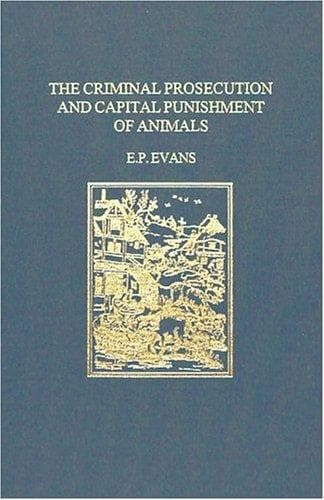
The Criminal Prosecution and Capital Punishment of AnimalsEvans, E. P. (Edward Payson)
History
The Criminal Prosecution and Capital Punishment of Animals
Evans, E. P. (Edward Payson)
Animals -- Law and legislation -- History; Animals, Prosecution and punishment of -- History; Trials -- Europe
that the complainants, instead of instituting judicial proceedings, would
do better to entreat the mercy of heaven and to imitate the Ninevites,
who, when they heard the warning voice of the prophet Jonah, proclaimed a
fast and put on sackcloth. In conclusion, he demands that the petition of
the plaintiffs be dismissed, the monitorium revoked and annulled, and all
further proceedings stayed, to which end the gracious office of the judge
is humbly implored (_humiliter implorato benigno officio judicis_).
The case was adjourned to the 12th and finally to the 19th of June, when
Petremand Bertrand, the prosecuting attorney, presented a lengthy
replication, of which the defendants’ advocate demanded a copy with due
time for deliberation. This request led to a further adjournment till the
26th of June, but as this day turned out to be a _dies feriatus_ or
holiday, no business could be transacted until the 27th, when the advocate
of the commune, François Fay (who seems to have taken the place of Amenet,
if he be not the same person), in reply to the defendants’ plea, argued
that, although the animals were created before man, they were intended to
be subordinate to him and subservient to his use, and that this was,
indeed, the reason of their prior creation. They have no _raison d’être_
except as they minister to man, who was made to have dominion over them,
inasmuch as all things have been put under his feet, as the Psalmist
asserts and the apostle Paul reiterates. On this point, he concludes, our
opponent has added nothing refutatory of the views, which have been held
from time immemorial by our ancestors; we need only refer to the opinions
formerly expressed by the honourable Hippolyte Ducol as satisfactory. The
advocate for the defence merely remarked that he had not yet received the
document ordered on the 19th of June, and the further consideration of the
case was postponed till the 4th of July. Antoine Filliol then made a
rejoinder to the plaintiffs’ replication, denying that the subordination
of the lower animals to man involves the right of excommunicating them,
and insisting upon his former position, which the opposing counsel had not
even attempted to disprove, namely, that the lower animals are subject
solely to natural law, “a law originating in the eternal reason and
resting upon a basis as immutable as that of the divine law of revelation,
since they are derived from the same source, namely, the will and power of
God.” It is evident, he adds, that the action brought by the plaintiffs is
not maintainable and that judgment should be given accordingly.
Public-domain text, read in full here on John Shaqi.
Reviews
Reviews
No reviews yet
Be the first to share your thoughts on this work.
Join the Discussion
Join the discussion
Sign in to leave a comment or review.
Sign InorCreate an account