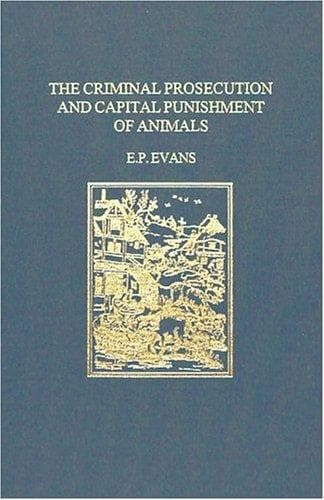
The Criminal Prosecution and Capital Punishment of AnimalsEvans, E. P. (Edward Payson)
History
The Criminal Prosecution and Capital Punishment of Animals
Evans, E. P. (Edward Payson)
Animals -- Law and legislation -- History; Animals, Prosecution and punishment of -- History; Trials -- Europe
One of the strong points made by the counsel for the defence in
prosecutions of this kind was that these insects were sent to punish man
for his sins, and should therefore be regarded as agents and emissaries of
the Almighty, and that to attempt to destroy them or to drive them away
would be to fight against God (_s’en prendre à Dieu_). Under such
circumstances, the proper thing to do would be, not to seek legal redress
and to treat the noxious creatures as criminals, but to repent and humbly
to entreat an angry Deity to remove the scourge. This is still the
standpoint of Christian orthodoxy, Protestant as well as Catholic, and the
argument applies with equal force to the impious and atheistic
substitution of Paris green and the chlorate of lime for prayer and
fasting as exterminators of potato-bugs. The modern, like the mediæval
horticulturist may ward off devouring vermin from his garden by the use of
ashes, but he strews them on his plants instead of sprinkling them on his
own head, and thus indicates to what extent scientific have superseded
theological methods in the practical affairs of life.
Thomas Aquinas, the “angelic doctor,” in his _Summa Theologiæ_ raises the
query, whether it is permissible to curse irrational creatures (_utrum
liceat irrationabiles creaturas adjurare_). He states, in the first place,
that curses and blessings can be pronounced only upon such things as are
susceptible of receiving evil or good impressions from them, or in other
words, upon sentient and rational beings, or upon irrational creatures and
insentient things in their relation to rational beings, so that the latter
are the objects ultimately aimed at and favourably or unfavourably
affected. Thus God cursed the earth, because it is essential to a man’s
subsistence; Jesus cursed the barren fig-tree symbolizing the Jews, who
made a great show of leafage in the form of rites and ceremonies, but bore
no fruits of righteousness; Job cursed the day on which he was born,
because he took from his mother’s womb the taint of original sin; David
cursed the rocks and mountains of Gilboa, because they were stained with
the blood of “the beauty of Israel”; in like manner the Lord sends locusts
and blight and mildew to destroy the harvests, because these are
intimately connected with the happiness of mankind, whose sins he wishes
to punish.
Public-domain text, read in full here on John Shaqi.
Reviews
Reviews
No reviews yet
Be the first to share your thoughts on this work.
Join the Discussion
Join the discussion
Sign in to leave a comment or review.
Sign InorCreate an account