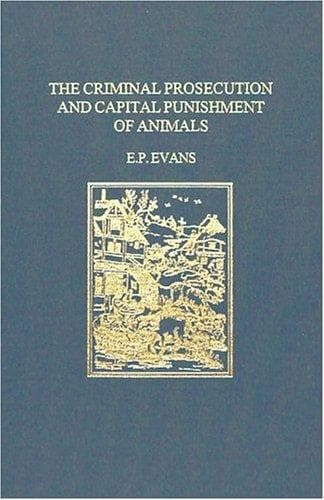
The Criminal Prosecution and Capital Punishment of Animals — John Shaqi
The Criminal Prosecution and Capital Punishment of AnimalsEvans, E. P. (Edward Payson)
History
The Criminal Prosecution and Capital Punishment of Animals
Evans, E. P. (Edward Payson)
Animals -- Law and legislation -- History; Animals, Prosecution and punishment of -- History; Trials -- Europe
It is laid down as a legal maxim by mediæval jurisprudents that no animal
devoid of understanding can commit a fault (_nec enim potest animal
injuriam fecisse quod sensu caret_). This doctrine is endorsed by the
great theologian and scholastic Thomas of Aquino. If we regard the lower
animals, he says, as creatures coming from the hand of God and employed by
him as agents for the execution of his judgments, then to curse them would
be blasphemous; if, on the other hand, we curse them _secundem se_, i.e.
merely as brute beasts, then the malediction is odious and vain and
therefore unlawful (_est odiosum et vanum et per consequens illicitum_).
There is, however, another ground, on which the right of excommunication
or anathematization may be asserted and fully vindicated, namely, that the
lower animals are satellites of Satan “instigated by the powers of hell
and therefore proper to be cursed,” as the Doctor angelicus puts it.
Chassenée refers to this opinion in the treatise already cited (I. § 75),
and adds “the anathema then is not to be pronounced against the animals as
such, but should be hurled inferentially (_per modum conclusionis_) at the
devil, who makes use of irrational creatures to our detriment.” This
notion seems to have been generally accepted in the Middle Ages, and the
fact that evil spirits are often mentioned in the Bible metaphorically or
symbolically as animals and assumed to be incarnate in the adder, the asp,
the basilisk, the dragon, the lion, the leviathan, the serpent, the
scorpion, etc., was considered confirmatory of this view.
But not all animals were regarded as diabolical incarnations; on the
contrary, many were revered as embodiments and emblems of divine
perfections. In a work entitled _Le Liure du Roy Modus et de la Reyne
Racio_ (The Book of King Mode and Queen Reason), which, as the colophon
records, was “printed at Chambery by Anthony Neyret in the year of grace
one thousand four hundred and eighty-six on the thirtieth day of October,”
King Mode discourses on falconry and venery in general. Queen Reason
brings forward, in reply to these rather conventional commonplaces,
“several fine moralities,” and dilates on the natural and mystic qualities
of animals, which she divides into two classes, sweet beasts (_bestes
doulces_) and stenchy beasts (_bestes puantes_). Foremost among the sweet
beasts stands that which Milton characterizes as
“Goodliest of all the forest, hart and hind.”
Public-domain text, read in full here on John Shaqi.
Reviews
Reviews
No reviews yet
Be the first to share your thoughts on this work.
Join the Discussion
Join the discussion
Sign in to leave a comment or review.
Sign InorCreate an account